

Patti Smith: Earth Angel
The Godmother of Punk’s new memoir is the book of a lifetime

To say there were high expectations for the new Patti Smith memoir, Bread of Angels, would be putting it mildly.
Just Kids — Smith’s 2010 book about her friendship with the late visual artist Robert Mapplethorpe — was a major success. Among other things, it won the National Book Award — and for good reason. Just Kids beautifully captured not only the deep bond between Smith and Mapplethorpe but also the era in which they met. Even the people I know who aren’t big Patti Smith fans loved it. The problem with writing a book that amazing, of course, is following it up. M Train, which Smith released in 2015, certainly wasn’t bad. But she had set the bar so high with Just Kids that it couldn’t help but feel disappointing by comparison.
There is no such problem with Bread of Angels. This memoir — which was published in November by Random House — is a pretty extraordinary book. Admittedly, it covers a lot. Smith turns 79 today and she has led a singular life. Attempting to pack that entire life into less than 300 pages must have been a daunting task.
She begins Bread of Angels with a brief prelude in which she makes reference to the “rebel hump” (a term she comes back to periodically), memories of youth and the beautiful line “God whispers through a crease in the wallpaper.”
“Everyone is dead, all is forgotten, echoes a voice,” she writes. “I inventory those still with me [and] go no further than the face of my sister, innocent yet all knowing. So long as she is here our memories are ensured. But what of the future when we are both gone? Write for that future, says the pen, for the sake of the cast off lamb, swept away in the burning attic.”
Smith was born Dec. 30, 1946 in Chicago — the first child of Grant and Beverly Williams Smith. Her sister Linda and brother Todd followed quickly; the three were born in a three-year span! But her youngest sibling, Kimberly, arrived many years later.
Her childhood was simultaneously ordinary and extraordinary. Smith was an inquisitive girl, always asking questions and marching to the beat of her own drummer. Her family was far from wealthy and moved frequently, eventually settling in New Jersey. Her childhood was also an interesting mix of devouring books, playing games outside with Linda and Todd and enduring a seemingly endless series of physical ailments.
“During my first six years, I weathered one communicable disease after another: bronchial pneumonia, tuberculosis, German measles, mumps and chicken pox” she writes. “After the final stages of each assault, I would enter periods of lengthy bed rest, lying in my makeshift cot by the coal stove, picturing the characters in my books, spinning the adventures beyond the page… I believe that my own will coupled with natural remedies kept me alive.”
Though she was a sickly child, Smith was no coward — far from it. One of the defining moments of her childhood was when she scared off Jackie Riley, the neighborhood bully, while he was taunting her brother. “My siblings walked proudly by my side as we headed home,” she writes. “Toddy vowed forever to be my knight.” He kept his word.

More moves and more illnesses (including a serious bout with the Asian flu) followed. She also weathered pets dying, a hurricane and the general feeling of not fitting in. But these were tempered by her love of literature, music, bikes and her siblings. Her mother became a Jehovah’s Witness but their dogma proved too restrictive for Smith. “I spent many sleepless nights before making the decision to cease my Bible studies and not return to the Kingdom Hall… I had chosen my own path and decided to prepare myself for the life of an artist, pledging to be steadfast no matter the consequences.”
In 1966, Smith found herself unexpectedly pregnant at the age of 19. She neither kept the child nor aborted it but rather arranged for it to be adopted. And she panicked as she broke the news to her family.
“I stood before them, aware of their sacrifices, guidance and the illnesses they pulled me through. I’m pregnant, I said,” she writes. “I’ve taken on the responsibility and found a good family for the child… [I] instinctively turned to Todd who had always looked up to me. I’m pregnant, I repeated, so what do you think of me now? But before anyone could say a word Todd spoke up. He revealed to our collective shock that… he had secretly dressed in women’s clothing for years, and that all the missing pieces of our wardrobes were hidden in his closet beneath his baseball gear and comic books. He turned and looked at us all squarely… Then fixed his gaze on me. I’m half woman, half man. I’m a transvestite, he said. So what do you think of me now? He fell upon his sword for me, deflecting my dishonor.”
[As a side note, I learned a lot about Todd from reading this book and he was a fascinating person.]
From there, Smith recounts moving to New York City in the late ’60s. She quickly and fortuitously met Robert Mapplethorpe. “We rescued one another,” she writes. Together, Smith and Mapplethorpe pursued their respective artistic passions, met some of the denizens of the NYC counterculture and forged a lifelong friendship.
By the early ’70s, Smith had read poetry with Allen Ginsberg and Jim Carroll among others. After meeting guitarist Lenny Kaye, she began combining music and poetry in a way that would truly flower on her debut album Horses and inspire countless other artists. Richard Sohl — a classically trained pianist from Queens — came on board next. The three of them began looking for places to perform. One such place was a ratty bar on the Bowery called CBGB.
“When we started building CBGB’s as a place to play, it was because there was no [other] place to play for people like us,” said Smith the one time I interviewed her. “There was no place in New York City in 1973 for a poet improvising with a guitar player and a piano player. The only things there were maybe some gay cabarets that were really too sophisticated.”
AUDIO: Patti Smith “Piss Factory”
Not long after this, CBGB exploded. The Ramones, Blondie, Television, Talking Heads and Suicide were just come of the bands who were part of the burgeoning scene there. Though it was still an underground phenomenon — distanced from both the disco world uptown and the folk music world crosstown — record companies eventually took notice. Smith, Kaye and Sohl added second guitarist and bass player Ivan Kral and drummer Jay Dee Daugherty and the Patti Smith Group was officially born.
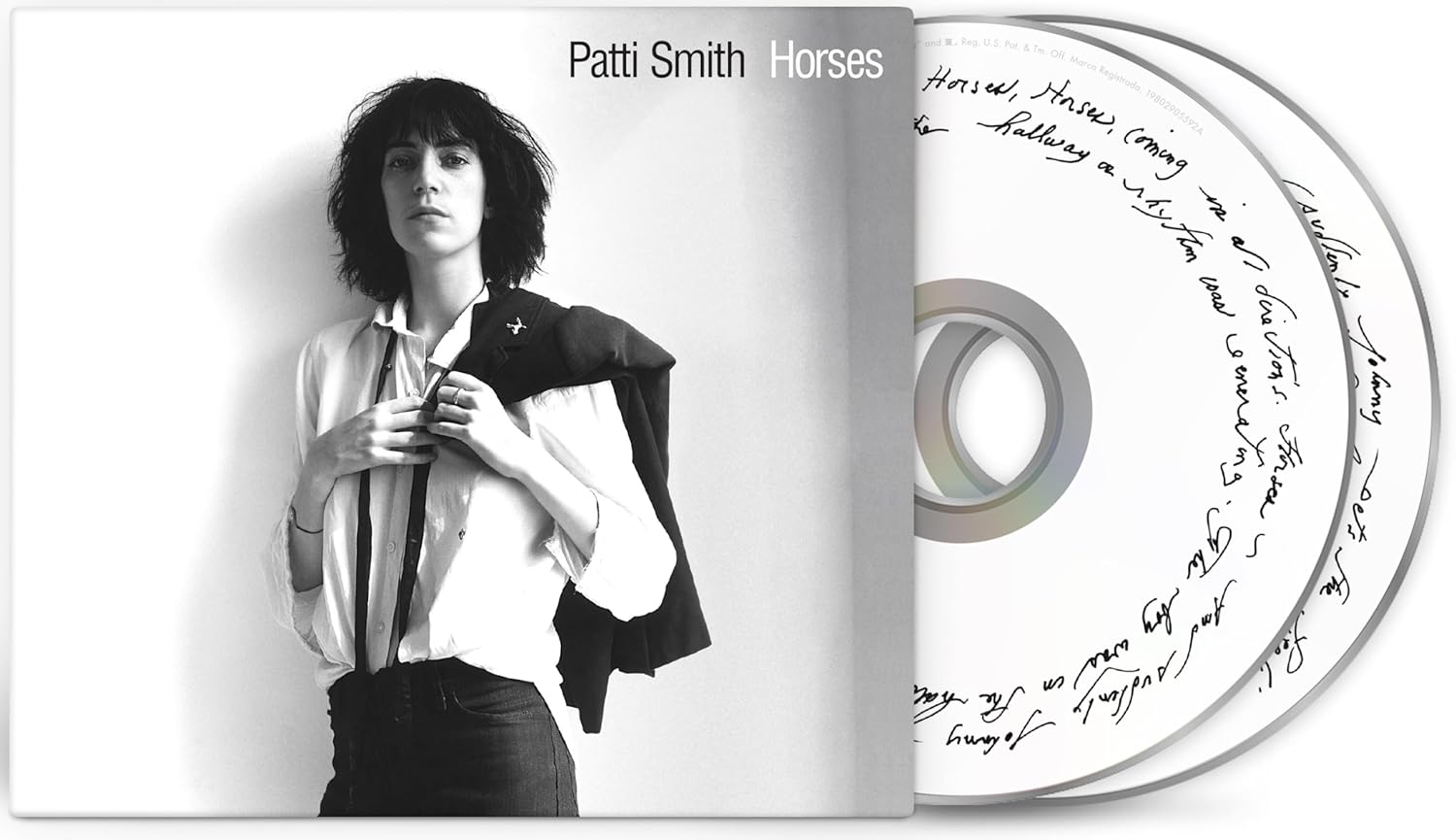
After honing her chops at CB’s and other venues, Smith signed to Arista Records. In September of 1975, they entered Electric Lady Studios with producer John Cale. There they recorded Horses, one of Smith’s best albums and one of the most influential debuts in rock history. Highlights ranged from shorter songs like “Free Money” and the reggae-tinged “Redondo Beach” to longer, improvisatory pieces like “Birdland” and “Gloria.”
“At midnight we recorded our version of ‘Gloria,’ crossing the Van Morrison classic with the poem ‘Oath’ that I had written in 1968. It seemed that every fledgling rock band had covered ‘Gloria’ but perhaps not a female singer…,” she writes. “Richard confidently laid out the opening chords as I half sung the words to ‘Oath,’ ‘Jesus died for somebody’s sins but not mine.’”
While on tour to support Horses, Smith encountered her future husband, former MC5 guitarist Fred “Sonic” Smith, for the first time.
“We landed in Detroit on a windy Tuesday afternoon. The crew left for Ford Auditorium to set up our equipment and the rest of us went straight to a welcome party hosted by the Detroit music community… That’s when I first saw him. He stood by a white radiator in a blue overcoat. I noticed the threads where a button was missing. That fleeting moment was to redirect the whole of my life… I knew in that moment he was the one I would marry.”
[As much of a romantic as I am, I’m also cynical about love at first sight. But if you believe Smith — which I do — that’s what it was. They did marry in 1980 and were rarely apart in the 14 years that followed.]
The Patti Smith Group, meanwhile, would release three more albums between 1976 and 1979: Radio Ethiopia, Easter and Wave. Apart from an incident on one tour where she slipped off the stage and fractured her skull and spine, there were generally happy and productive years for Smith. She even scored a big hit with “Because the Night,” a passionate rocker from Easter co-written with Bruce Springsteen. She worked with great producers and hired Todd to be the head of her road crew.
AUDIO: The Patti Smith Group “Because the Night”
At the end of the 1970s, Smith made the unusual — and to many people shocking — decision to leave New York City and music. She decided to move to Detroit to be with Fred.
“Before returning to Detroit, I stopped in New York [to] see William Burroughs. He sat quietly, with his hands folded, as I told him what I had done and where I was going. Afterwards, he simply asked What does he have to offer you? Himself, I answered… With an old plaid suitcase covered in stickers, I returned to Detroit. I did it for love. I did it for art. But moreover, I did it for myself. It was time to cast off my old coat. The rebel hump shuddered. Walking away was my second declaration of existence.”
From there, Smith discusses her “missing years” as it were: The period between roughly 1980 and 1995 when she lived in Detroit, raised a family with Fred and (aside from the 1988 Dream of Life album) released no new music. In a life of brave and unconventional choices, stepping away from music at the height of her popularity may have been the bravest. But it’s clear that these were happy years for Smith. Perhaps like John Lennon, she devoted herself to domesticity as deeply as she had devoted herself to music. And she continued to write prose and to draw. Among other things, Smith describes her and Fred’s honeymoon (which almost didn’t happen when their plane was struck by lightning!), their search for a home in Michigan, Fred’s interest in boats and the births of their son Jackson and daughter Jesse.
“The desire for illumination eclipsed that of ambition…,” she writes. “Our life was obscure, perhaps not so interesting to some, but for us it was a whole life. Sometimes challenging, yet I could feel myself evolving in slow but real time.”
Toward the tail end of the ’80s, however, Smith’s life was upended by a series of unexpected, tragic and premature losses. Mapplethorpe was the first loss, as he succumbed to AIDS in 1989.
Unbeknownst to Smith, this was just the beginning. Richard Sohl died suddenly of heart failure the following year. Not only had Smith remained friends with the piano player through the years but the normally guarded Fred had become quite fond of him.
“Richard died in the arms of our friend Danny Fields,” she recalls in Bread of Angels. “Fred quietly wept, then went outside and sat alone by the canal. Richard was only 37 years old; he had quit smoking, cropped his curls and had never seemed more alive.”
By comparison, the next few years were uneventful for Smith — but then came 1994. Though she doesn’t delve too deeply into her husband’s physical and emotional challenges, she certainly acknowledges them.
“His decline was the tragedy of my life,” she writes. “[But] it profits no one to outline the private battles of a very private man. When Fred went into the hospital, Linda and Toddy flew to Michigan to be with the kids… He had never been admitted to the hospital and believed if he ever were, he would never leave. There was a page-a-day calendar tacked to the wall and he stopped to tear off yesterday’s page. I looked up at the date and shuddered — November 4th, Robert’s birthday. Fred died that afternoon, in the hospital where our children were born. Birth, love and death, never touching, ever connected.”
Incredibly, Smith would suffer an equally devastating loss before the year was through. One month later — literally on Dec. 4th — Todd died suddenly.
“My brother suffered a massive stroke while wrapping Christmas presents for his daughter,” she writes. “Beside him was an open sports page and an ashtray filled with butts, but Rachael [Todd’s female alter ego] had the last word. Her hair, clothing and makeup were perfect.”
A few months later — as 1994 segued into 1995 and after consulting with friends — Smith made the decision to return to New York City and to music.
“Eventually it was time to reenter the world, to work and repay my debts… Though not photographed by Robert, accompanied by Richard or with my brother serving attentively in the wings,” she writes. “I would sometimes freeze. How could Robert, Richard, Fred and Todd, none older than 45, all be gone?”
Smith was still signed to Arista and began work on the album that would become Gone Again (it had started out as a collaboration with Fred called Going West). Lenny Kaye and Jay Dee Daugherty returned on guitar and drums, respectively. And Kaye brought in his friend Tony Shanahan to serve as bassist and music director.
Her return to music was well-received — and it continued. Smith released several more studio efforts, as well as the compilation Outside Society, and toured both domestically and internationally. In the last 50 pages or so of the book, she gives us an overview of these things but also returns to more family-oriented matters: the deaths of both parents and the shock of finding out — less than a decade ago — that Grant Smith was not her biological father. Curious about a family rumor, Smith and her sister Linda decided to take a genetic test — two tests actually.
“The results of my test were delayed, arriving on the morning of my 70th birthday,” she reveals in the book. “Once again, I would be obliged to rearrange my entire universe… It was a vial of saliva that exposed the undisputable truth of my parental source… My blood father was from a line of wanderers, uprooted and replanted to spring elsewhere, one hundred percent Ashkinazi.”
Smith describes the multitude of attendant feelings after getting this news. There was shock, of course. But there was also sadness that she and Linda were actually half-sisters, curiosity about her birth father (a Jewish pilot named Sidney) and even gratitude to Grant Smith who raised her as his own child.
The final chapter of Bread of Angels, “Vagabondia,” is a series of essays in which we follow Smith around the world while also going into her soul.
“In a certain way I have not changed so much. But the incandescent restlessness has somewhat quelled and a sense of all the things I loved are so deeply absorbed that I can project ‘Guernica’ without seeing it, hear My Bloody Valentine without listening, leaf through ‘The Glass Bead Game’ without reading… All must fall away” she writes. “The precious bits of cloth folded away in a small trunk like an abandoned trousseau, the books of my life, the models in their cases. Shedding is one of life’s most difficult tasks… In the shedding what remains is honor. We evolve, we falter, we learn from our transgressions and then repeat them. We plunge back into the abyss we labored to exit and find ourselves within another turn of the wheel. And then, having the fortitude to do so, we begin the excruciating yet exquisite process of letting go.”
2025 has been a banner year for Smith. It marked the 50th anniversary of Horses, which she celebrated with a series of concerts in which she performed the album in full. She was also honored this past March with a tribute at Carnegie Hall; I actually had the pleasure of attending that show, which saw artists ranging from Ben Harper to Bruce Springsteen to Maggie Rogers to Michael Stipe perform her songs. And now comes her memoir.
AUDIO: Patti Smith “Banga”
If I have any complaints about Bread of Angels, they are few and minor. I would have liked Smith to get into the making of Peace and Noise and Banga, two of my favorite albums of hers. But again — it’s hard to sum up a life in less than 300 pages. It’s even harder to sum up a life that has had as much love and loss, as many successes and shocks, as Smith’s has. So I’m inclined to cut her some slack. Moreover, she continues to be a special person above and beyond her music. I can only speak for myself, of course, but I doubt I’m the only one who has been inspired by her resilience over the years.
Thank you, Patti — for this book, for the music and for being who you are. Happy Birthday and Thank You.

- Gumboots: Paul Simon’s ‘Graceland’ Turns 40 - August 27, 2026
- In Quintessence: Squeeze’s ‘East Side Story’ At 45 - May 15, 2026
- If the ‘Shoes’ Fit… - March 31, 2026
You May Also Like
-
 December 13, 2023
 -
 March 8, 2020
 -
 March 29, 2025

Thank you, David. I really appreciate your thoughtful writings and the love of music you share when writing about artists and their work!