
In Quintessence: Squeeze’s ‘East Side Story’ At 45
Looking back on the band’s greatest album
Few bands of the New Wave era are more beloved than Squeeze.
The London-based quintet was certainly punk adjacent when they first got together in the mid ‘70s. But their music — while sometimes manic and often irreverent — was generally more melodic and less angry than punk. They released a string of classic singles in the late ‘70s and early ‘80s — among them “Cool for Cats,” “Up the Junction,” “Another Nail In My Heart,” “Pulling Mussels (from the Shell),” “Tempted” and “Black Coffee in Bed.” That’s why it’s somewhat shocking when you learn that Squeeze did not hit the US Top 40 until 1987! The song that finally did the trick was “Hourglass.” That hit was included on Babylon And On, the second album Squeeze released in their second incarnation.
But let’s not get ahead of ourselves.
Squeeze formed in the mid 1970s when singer-guitarist Glenn Tilbrook answered an ad placed by fellow singer-guitarist Chris Difford. In their first incarnation, the band was rounded out by keyboardist Jools Holland, bassist Harry Kakoulli and drummer Gilson Lavis. Difford and Tilbrook proved to be a match made in heaven in more ways than one. Their vocal harmonies were very distinct; there was something appealingly off-kilter about the contrast between Tilbook’s higher, more melodic voice and Difford’s deeper, less emotional one. But it worked.
Even more importantly, Difford and Tilbrook’s songwriting abilities complimented each other naturally. The pair was often compared to Lennon and McCartney. High praise to be sure — and there was some truth in that comparison. Like Lennon and McCartney, Difford and Tilbrook wrote pop songs with depth. They were capable of writing in a number of styles (while always staying true to their New Wave and pub rock roots) and they sometimes peppered their lyrics with distinctly British references. Where they differed (no pun intended!) from The Beatles was that their songs were generally collaborative. Difford nearly always wrote the lyrics while Tilbrook was responsible for the music. In any case, they were a great writing team and the quality of their songs grew by leaps and bounds during their first run.
Squeeze named themselves after the Velvet Underground album that featured no original band members. And they got former Velvets violist and songwriter John Cale to produce their debut. That eponymous LP arrived in 1978. The band was still finding its legs, though. While not a bad record, UK Squeeze wasn’t their strongest work and was only a minor success in England. But things changed quickly.
Their sophomore set, 1979’s Cool for Cats, fared better. Bassist Kakoulli was replaced by John Bentley, who would remain with the band through their first incarnation. Producer John Wood seemed to understand Squeeze better than Cale had. And Difford and Tilbrook responded with a better and more consistent set of songs. In the U.K., Cool for Cats spawned two huge U.K. hits: the witty title track (which finds Chris Difford doing what is nearly a Cockney rhyming slang rap!) and “Up the Junction,” a wonderful, midtempo tune sung by Tilbrook about a doomed relationship. Difford was already an accomplished lyricist — equally adept at songs that were witty and poignant — and the band was becoming a tight unit.
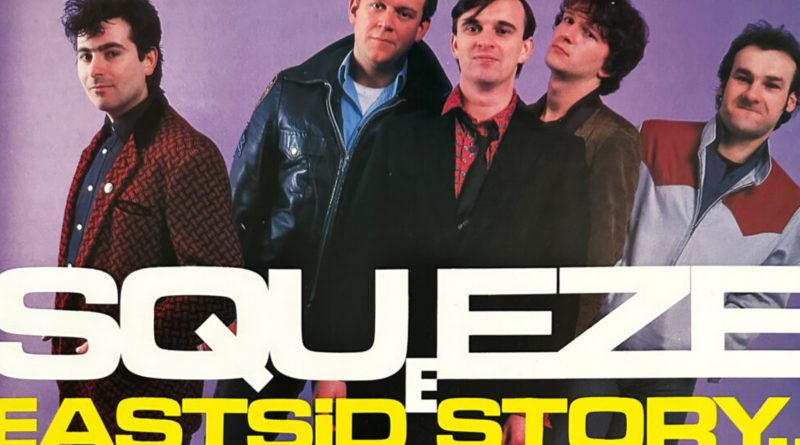
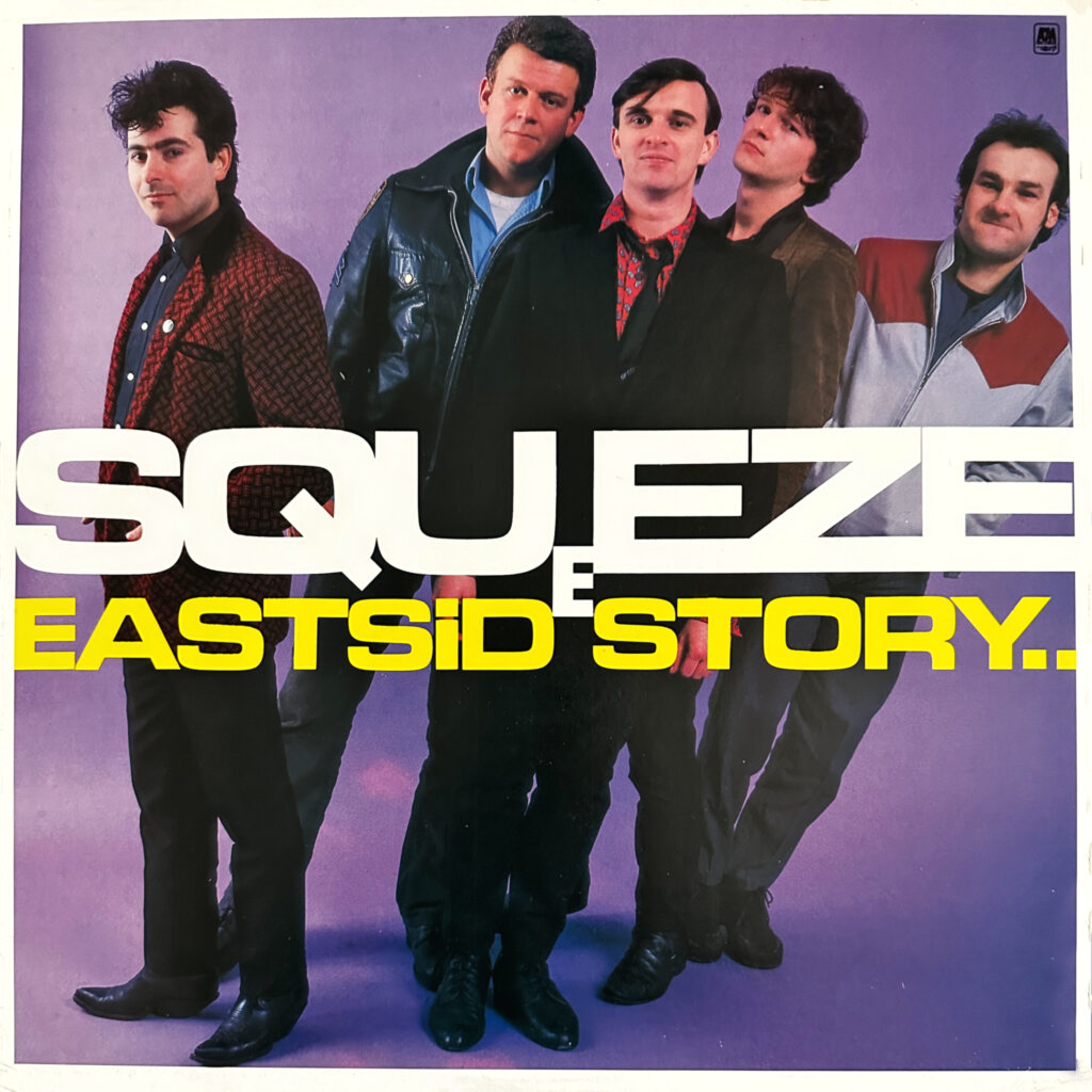
The following year’s Argybargy continued their winning streak. Working with John Wood again, Squeeze turned in some of their best material yet. The opening one-two punch of “Pulling Mussels (From The Shell)” and “Another Nail in My Heart” kicked things off in fine style while the clever, catchy “If I Didn’t Love You” was a minor hit in the States. And that brings us to their fourth studio effort (and first masterpiece), East Side Story.
More changes preceded the making of East Side Story, which was released on May 15th, 1981. Keyboardist Holland left the band after playing on their first three albums. While there’s no question that he was a good musician, his cigar chomping image and taste for boogie-woogie piano was increasingly at odds with the direction Difford and Tilbrook were heading in. (Of course, he would later become the internationally known host of the TV series Later with Jools Holland!) His replacement, Paul Carrack, would prove to be a significant asset to Squeeze. Not only was Carrack a good keyboardist; he was also an experienced and talented singer, having previously been part of the pub-rock band Ace who scored a blue-eyed soul hit with “How Long.” So the new lineup of Squeeze boasted three singers, a pair of fine writers and a damn good rhythm section.
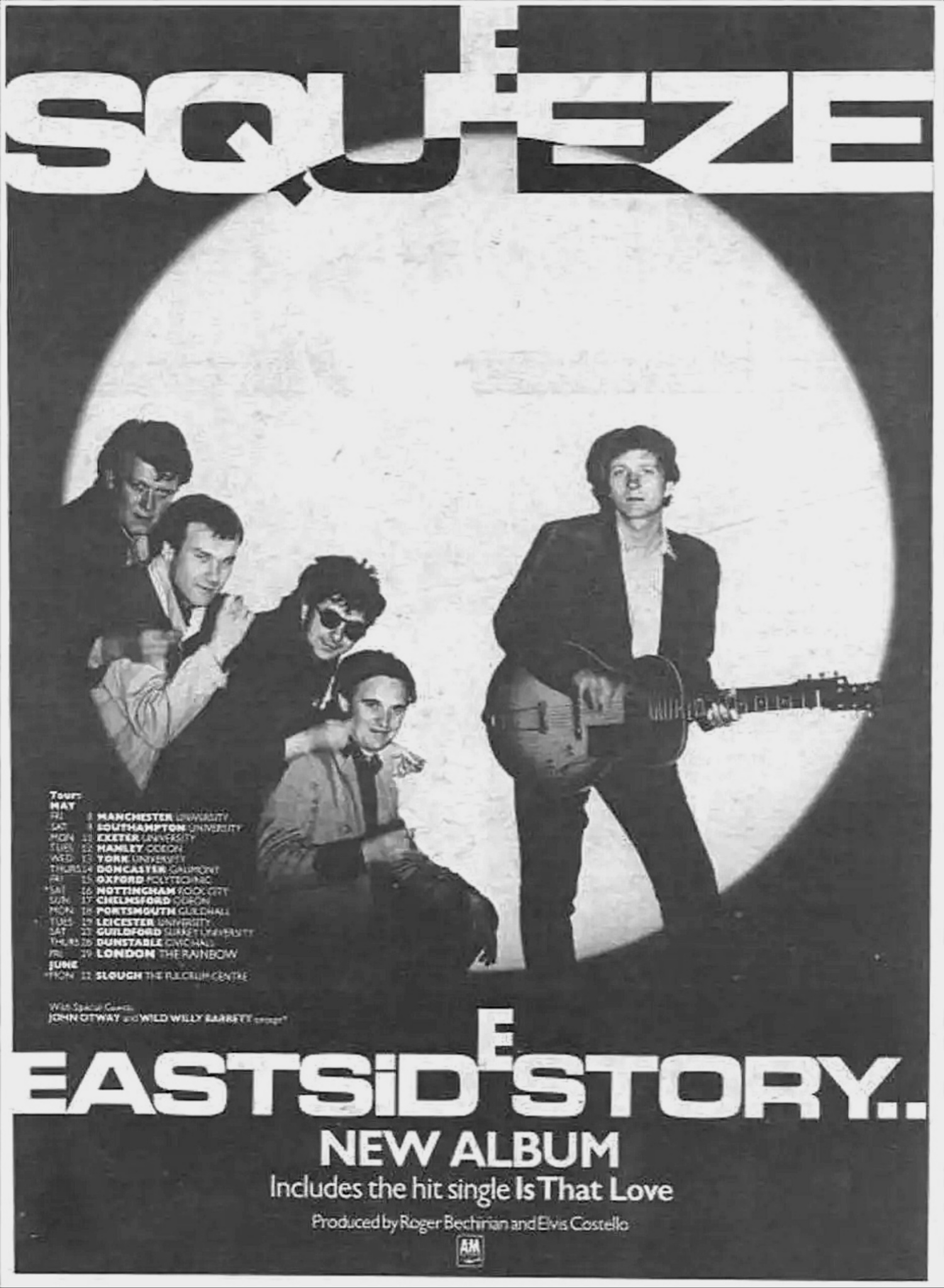
Equally important, the band decided not to work with John Wood this time around. East Side Story was initially going to be a double album with each of its four sides helmed by a different producer. Legend has it these four producers were supposed to be Elvis Costello, Dave Edmunds, Nick Lowe and Paul McCartney. Needless to say, that didn’t happen — but the first three were definitely within the realm of possibility. Like the members of Squeeze themselves, Costello, Edmunds and Lowe were veterans of the mid to late ‘70s U.K. pub-rock scene. That scene was fairly incestuous with many artists working together in various combos and influencing each other. (Check out the song “Pet You and Hold You” from Rockpile’s one fabulous album Seconds of Pleasure. If you didn’t know better, you’d swear it was Squeeze!)
In the end, East Side Story was a single record produced mainly by Roger Bechirian (who handled more of the technical side of things) and Costello (who added creative input). However, there was one track that Dave Edmunds produced. You’d be forgiven for thinking that track is “Messed Around,” the rockabilly tune that closes the album — but you would be wrong! Edmunds actually helmed the opening track, “In Quintessence,” with assistance from Neill King.
That song kicks the disc off in fine fashion. “In Quintessence” is a concise pop masterpiece about a hopeless young chap who “smokes himself into double vision.” (I still remember the song blasting from the stereo of my college friend Gigi and her roommates.) It’s vintage Squeeze: clever lyrics, catchy melody and Difford and Tilbrook singing in unison. That opener is followed by “Someone Else’s Heart.” Difford takes lead vocals on this one, a song about infidelity that manages to be foreboding and catchy at the same time. Next up is “Tempted,” a blue-eyed soul nugget that found Paul Carrack singing lead and that became Squeeze’s biggest American hit up to that point (despite it being seemingly ubiquitous, “Tempted” only made it to No. 49!). Batting cleanup is “Piccadilly,” a jaunty tune with Tilbrook on lead vocals. Carrack’s piano supplies the backdrop for one of Difford’s funniest lyrics. This writer’s favorite line is “A man behind me talks to his young lady/He’s happy that she is expecting his baby/His wife won’t be pleased but she’s not been round lately.” Brilliant!
VIDEO: Squeeze “Tempted”
(For those keeping score — we’re now four songs in. Every one of them has been a winner and the last three have all featured a different lead vocalist. Can we take a moment to appreciate that? Okay, now back to our regularly scheduled programming.)
Up next is “There’s No Tomorrow,” a slower song with a slight psychedelic feel that features Tilbrook on lead vocals. That’s followed by “Heaven,” an upbeat, off-kilter stunner with Difford on lead vocals and a prominent bass line from John Bentley. Side one closes with the sublime “Woman’s World,” a midtempo track with Tilbrook singing lead. It features one of many lyrics Difford wrote that are sympathetic, nuanced observations about an unnamed woman.
Side two leads off with “Is That Love,” a concise and catchy song with a Beatlesque guitar solo that was a minor hit. From there, it’s back to somewhat psychedelic territory with “F-Hole.” Not the best track on East Side Story, as it goes on a bit too long without really going anywhere. That said, “F-Hole” is not a bad tune and it segues nicely into the ballad “Labelled with Love.” That song, despite its country music influence and lyrics about heartbreak and alcohol, was a bigger hit across the pond than it was here.
Batting cleanup on side two is “Someone Else’s Bell,” a punchy pop song about infidelity that includes the great line, “If the grass seems greener but it turns out to be blue/The garden of Eden isn’t quite the place for you.” Next up is the frantic “Mumbo Jumbo,” followed by the lovely “Vanity Fair.” The latter is yet another poignant portrait of a woman set to a Baroque arrangement that would make Eleanor Rigby proud. The album closes with the aforementioned “Messed Around,” a rockabilly tune with clever lyrics. And here’s where this (East Side) Story ends. If I have any complaint about side two, it’s that Tilbrook takes lead vocals on every track. Don’t get me wrong; he’s a great singer. But it would have been nice to have a second song with Carrack on lead (or a third with Difford for that matter).
That’s just a quibble, though, as East Side Story is terrific. There’s no question that it’s the high water mark of Squeeze’s first incarnation and one of the best albums of the New Wave era. In the UK, it went Top 20 and produced several big hits. Here in the States, it only made it to No. 44 on the Billboard charts. But it received stellar reviews on both sides of the pond.
Squeeze would release one more studio set, 1982’s Sweets from a Stranger, before calling it quits for several years. They would go on hiatus again in the late 90s for roughly a decade. Currently, the band is touring in support of their fifteenth studio disc, Trixies. Difford and Tilbrook have issued solo albums over the years with varying degrees of success.
Having interviewed both (Tilbrook repeatedly!), I can tell you that they are very different types of people — chalk and cheese, to use the British expression. But both are talented and their talents compliment each other perfectly. Tilbrook is not only a great singer but also an excellent, underrated guitarist. For his part, Difford is a better vocalist than a cursory listen to Squeeze would lead you to think. And few can touch him as a lyricist. But while they’ve both produced fine work as solo artists, the songs they have co-written are truly magical. East Side Story is the proof.

- In Quintessence: Squeeze’s ‘East Side Story’ At 45 - May 15, 2026
- If the ‘Shoes’ Fit… - March 31, 2026
- Lowdown: Boz Scaggs’ Silk Degrees Turns 50 - February 19, 2026
You May Also Like
-
 July 6, 2022
 -
 September 30, 2019
 -
 December 13, 2020
