
Tomorrow Never Knows: The Beatles’ Revolver Turns 60
An in-depth look into one of the Fabs’ finest albums
The Beatles in 1966 were well into exploring the possibilities of the recording studio and LSD.
But the sessions that resulted in the classic Revolver, which turns 60 Aug. 5, also came about from one simple change of plans — the band no longer had to make a movie.
Manager Brian Epstein had planned for The Beatles to complete their three-picture deal with United Artists, filming a movie and writing a soundtrack album. But the band rejected a script for a comedic western — A Talent For Loving, based on a Richard Condon novel which later was made in 1969 starring Richard Widmark. There was also Shades of a Personality, in which the other three would play different parts of John Lennon’s split personality. But that film, even when playwright Joe Orton took it on under the title of Up Against It the following year, was never made.
So it was that The Beatles, a band which went from their seismic first Ed Sullivan Show appearance to breaking up in less than six years, had something rare — time off, three months’ worth.
They pondered other recording studio possibilities in America, starting with Stax, but wound up back at the old familiar environs of EMI Studios in London.
When asked in March what the album would sound like, John Lennon told the NME, “Literally anything. Electronic music, jokes… One thing’s for sure — the next LP is going to be very different.”
George Martin was back producing, this time with Geoff Emerick moved up to engineer, as EMI had promoted Norman Smith to producer (he’d go on to be in that chair for Pink Floyd’s Piper at the Gates of Dawn and the Pretty Things’ S.F. Sorrow in the next couple years).
The band, starting in April, would spend 31 days in the studio over a two-and-a-half month span recording the album.

Acid had entered the picture the previous year. The first time, Lennon and George Harrison’s dentist dosed them and their wives after dinner without consent, resulting in a mixed experience. It felt profoundly life-changing to Harrison, nightmarish to Cynthia Lennon and somewhere in between for John, although he wanted to try it again.
Thus, while on break in Los Angeles in August 1965, The Beatles, well before AirBNB, they leased Zsa Zsa Gabor’s house in Benedict Canyon for eight days. John and George decided to try again, wanting the other two Beatles in on the experience. Ringo Starr joined in, but Paul McCartney still held out.
Not that McCartney was content to settle for milk and cookies. According to the memoir of actress Peggy Lipton, at this point a few years away from The Mod Squad, she and Paul enjoyed both weed and each other’s intimate company.
Meanwhile, the other three were among those enjoying acid at the house of one of the stars at Zsa Zsa’s house, along with others including David Crosby and Roger McGuinn of The Byrds and actor Peter Fonda, the latter of whom would inspire one of Revolver’s songs that day.
Either by year’s end or early 1966, McCartney would finally try the drug, though at another friend’s house and not with any of the other Beatles. Indeed, while he would later come across as not disliking the drug entirely, it wasn’t for him, as weed was more his speed.
Indeed, while there’s no denying its influence on Revolver, none of the Fabs kept using it long-term with John reportedly being the last to stop, perhaps having someone get in his ear after a day after a night time tripping in 1968 when he wanted to call a press conference to announce he was Jesus Christ.
Fonda had been given his dose by Crosby who, at some point, told him that Harrison needed some talking down. In his memoir, Don’t Tell Dad, Fonda said, “David Crosby came and got me. I don’t know why it was me, and said, ‘George is in trouble…’ So I had to go over there and say, ‘Don’t worry about it, George, this is what this drug does, it puts your mind, your brain, out of activity of the function you think it’s in… It unlocks the doors of perception…'”
In his state, Fonda started referencing a time in his youth when he accidentally shot himself in the stomach, nearly dying due to blood loss and requiring months of recovery.
VIDEO: The Beatles “She Said She Said”
It didn’t go over well, Harrison thinking Fonda was “uncool” and Lennon saying later, “Peter Fonda kept sitting next to me, and whispering, ‘I know what it’s like to be dead….’ We were saying, ‘For chrissakes, shut up, we don’t care! We don’t want to know!'”
At some point, they asked Fonda to leave, but the experience stuck with Lennon, who started writing the song “He Said,” which became “She Said, She Said.” It became the last song recorded for the album in June.
Parts of the lyrics came directly from that day in Benedict Canyon, even with the gender flip, as Lennon told Fonda at one point, “You’re making me feel like I’ve never been born.”
Catchy with a well-executed back-and-forth meter change partway through, the songs lyrics go beyond a tripping actor bumming out a couple of moptops (Ringo was too busy attempting to play pool with the cue turned around) back to childhood before John’s mother was killed when she was run over by an off-duty cop when John was 17.
Even though listeners didn’t know the Gabor connection, there was no mistaking that the band was unapologetically experimenting in more ways than one, to a greater degree than they did on 1965 predecessor Rubber Soul.
Another lysergically influenced Lennon track was the closer — “Tomorrow Never Knows.” It was inspired by the Tibetan Book of the Dead and a book it led to — Psychedelic Experience: A Manual Based on the Tibetan Book of the Dead by Timothy Leary, Richard Alpert and Ralph Metzner.
Heard in its early form in demo versions on later reissues, the song was more of a pallid Indian dirge, but the pace picked up.
One of Ringo’s best drum performances which, contrary to other sounds on the song, was not looped gives a propulsive example of Newton’s First Law of Motion, even while lurching.
VIDEO: The Beatles “Tomorrow Never Knows”
Lennon gave a non-musical example of what he wanted his vocals to sound like, basically as if he were a guru pronouncing from a mountaintop.
Emerick improvised the solution. Lennon’s vocals were routed through a Leslie speaker, normally used as an amp for Hammond organs. The speaker was rotated on what was basically a large, improvised lazy susan.
Lennon’s vocals were double-tracked through artificial means to add to the effect, there were various loops and snippets of backwards instruments thrown in for disorienting measure, with McCartney, who’d grown interested in avant garde underground music, throwing in some Stockhausen techniques.
If, as Harrison later said, Lennon didn’t quite get the full concept and benefit of the form of meditation he was writing about, the end result was a psychedelic masterpiece with no consumption required on the part of the listener.
It’s definitely one of Revolver’s songs that’s grown in estimation over the years, even if some didn’t get it at the time. The respected Paul Williams, in Crawdaddy, called it “predictable and uninteresting,” finishing by saying, “It’s the sort of thing The Beatles should be doing for their own benefit but not yet putting on records. A good artist doesn’t publish first drafts.”
Given the circumstances of John and George’s first acid trip, it’s easy to assign “Doctor Robert” to the man that dosed them that day. But it’s never definitively assigned to an actual subject. It could have been the dentist, a scene person like Robert Fraser, Robert Freymann (a New York doctor of the time who had a lot of well-heeled and elite clients who would get vitamin shots from him with plenty of amphetamines as a ‘boost’) and even the songwriter Lennon himself (according to a 1980 interview where he said he was the one in the band with all the pills on tour).
Regardless, the song, the most straightforward Lennon is on the whole album, plays like a commercial for the Dr. Feelgood in question.
Harrison, getting three songs on a Beatles album for the first time, turned acid into dissonant pop on “I Want To Tell You,” turning the potentially overwhelming into a relatable song about the inability to communicate.
As George put it in his 1980 autobiography I Me Mine, the song was about “the avalanche of thoughts that are so hard to write down or say or transmit,” although there’s no urgency as he sings “I’ve got time” with high harmonies (pun not intended) from John and Paul behind him at the end.
McCartney may have sampled acid, but there’s no question he was more interested in what he’d continue to enjoy for years (just ask 1980 Japanese law enforcement).
“Got To Get You Into My Life” was “actually an ode to pot, like someone else might write an ode to chocolate or a good claret,” McCartney told author Barry Miles for the 1997 biography Paul McCartney: Many Years From Now.
The song took shape when the decision was made to add horns, which made it clear that Paul’s hat was tipped in Motown’s general direction. Stevie Wonder, who reportedly influenced the song, would return the favor in 1971 when he turned Rubber Soul’s “We Can Work It Out” into a straight-up Detroit hit.
VIDEO: The Beatles “Got To Get You Into My Life”
Paul definitely enjoyed playing coy at the time. John’s drug songs were clearly drug songs and George didn’t hide it. Paul made his seem like love songs.
“Good Day Sunshine” began as McCartney’s attempt to write his version of the Lovin’ Spoonful hit “Daydream,” a jaunty ditty about love (that could just as easily have been about a pleasant wake-and-bake although he always insisted it wasn’t). It has no guitar, creating a space where both Paul’s love for music hall mingles with classical and psychedelia (the way they handle the harmonic shift at the song’s end).
The Beatles were starting to chafe at EMI’s way of running things in the studio, so the band started to make its own rules. Emerick close miked Ringo’s drums throughout, a violation of EMI policy.
But this was The Beatles and concerns of the studio police aside, were they going to tell the world’s biggest band on a creative hot streak “No”?
Another example came in the first taste of what was to come on Revolver. Because the label wanted a single, two songs were finished and plucked from the recording sessions — McCartney’s “Paperback Writer” backed by Lennon’s “Rain.
“Paperback Writer” again ignored EMI dictates in its recording. McCartney, playing a Rickenbacker bass instead of his usual Hofner, went for more oomph. A speaker was used as a microphone, placed in front of the bass amp for even more punch.
The killer bassline with fuzzy guitar was combined with lyrics that were the result of McCartney, perhaps challenged by an aunt of his to do so, wanted to write a song about something other than young love.
While his Aunt Lil didn’t make the kind of brownies which would have made “Got To Get You Into My Life” clear, she could have easily understood the way McCartney turned from the aspirations of “Drive My Car” into those of the more hapless would-be author in “Paperback Writer.”
“Rain” was ostensibly Lennon complaining about people complaining about the weather, but took its own likely drug-fueled turn in playing with perception.
Ringo contributed one of his finest drum parts to that point, showing off his feel and knack of well-chosen fills. McCartney’s bassline became one of his most well-known.
VIDEO: The Beatles “Rain”
The woozy feel was the result of the studio trickery that The Beatles, with Martin and Emerick’s help, were beginning to engage in more freely. The song’s rhythm track was recorded at faster speed then slowed down to normal to alter its tone. Lennon’s lead vocals were given the opposite treatment, resulting in a slightly higher pitch on playback.
The backwards coda was either the result of a stoned Lennon accidentally playing a rough mix the wrong way on his reel-to-reel player (corroborated by Harrison and Emerick) or, according to Martin, an idea he had while Lennon was out of the studio.
In any case, it didn’t chart that high, but became more influential than the A-side.
Rubber Soul had no U.S. singles from its American version, but Revolver avoided being shut out with one single — “Yellow Submarine” with “Eleanor Rigby” as a double A-side
The former would be the third-and-final Beatles single with Ringo singing lead on the A-side, following “Matchbox” and “Boys,” peaking at No. 2 in the U.S. behind the Supremes’ “You Can’t Hurry Love.”
The common wisdom was the song was intended as a children’s song for Ringo, primarily driven by Paul. But earlier versions of it, included on the expanded 2022 reissue of the album, had John on lead vocals, first with a deep melancholy tone and then a feel that felt like it was conceived around a campfire.
The band had its basic catchy singalong, then went all-in on a one day session with sound effects from various sources — Harrison swishing water in a tub became waves, Lennon blowing a straw into a pan filled with water became bubbling, The Rolling Stones’ Brian Jones clinked glasses and played ocarina as part of a simulated party, the band that “begins to play” came from a rearranged bit of a recorded brass band from the EMI library.
To be sure, there was a bit of influence from the lads’ beloved sources of humor — Spike Jones and the hugely influential British radio comedy series (no Monty Python without it). McCartney’s exaggerated spoken repeating of Ringo’s sung lines (“sky of blue,” “sea of green”) were a Goon-inspired idea by Lennon.
The final result was certainly as playful and catchy as intended. The whimsy, not nearly as forced as on “Ob-La-Di, Ob-La-Da” would be two years later, didn’t land with everyone. Ray Davies called it “rubbish” at the time.
VIDEO: The Beatles “Yellow Submarine”
In retrospect, it is silly, but knowingly so and its experimentation with effects and sounds fits in with the rest of the album in its own way and a reminder that getting high wasn’t all getting bummed out in the hills above LA.
The song is a rather bizarre pairing for a double single with “Eleanor Rigby,” in which Paul is the one to write about organized religion, though it started as a song about an elderly woman that a younger McCartney used to do errands for and spend time with in Liverpool.
Though she was the inspiration, there really weren’t lyrics for it, as singer Donovan later attested in the Miles book (“‘Ola Na Tungee/Blowing his mind in the dark/With a pipe full of clay/No one can say”). The inspiration came when the line about picking up rice after the church wedding, leading to the “all the lonely people” hook (which came from George).
VIDEO: The Beatles “Eleanor Rigby”
The result was a sadder emotional core. In the end, Eleanor dies and Father McKenzie, as lonely as her, is trapped “writing sermons that no one will hear” and that “no one was saved.”
It’s not a treatise on faith, but rather depicts two lives for whom it offered only cold comfort.
Musically, it’s an intense successor to “Yesterday” in that it’s not a band number. John and George added harmony vocals to Paul’s lead. The musicians are all orchestral — four violinists, two cellists and two viola players.
The song, given its lyrics and a controversial regurgitated interview with Lennon, got less push from the label in the U.S., but did peak at No. 11, a chamber classic as time went on.
The most pointed lyrics came right out of the gate with Harrison, who was starting to emerge more as a writer, getting three songs on an album for the first time.
The lead song out of the album had always been John’s until Paul’s “Drive My Car” began Rubber Soul. This time, Martin felt that what he thought was George’s best track was the perfect way to introduce the album.
The Beatles, by this point, were starting to realize the money they had taken in and how much of it was being taken, to the point where Harrison felt bankruptcy was a concern, as he wrote in the opening lyric, “Let me tell you how it will be/There’s one for you, nineteen for me.”
The supertax would soon force those few bands making that kind of money to be creative. The Stones exploited residency loopholes by recording and touring outside the U.K. The Beatles would utilize companies like Northern Songs Ltd. and Apple to reduce their tax burdens.
And in Harrison’s case, though it didn’t make the lyrics, he was also unhappy the tax rate was being used to fund too much military spending.
VIDEO: The Beatles “I’m Only Sleeping”
The song was equal parts funky groove and stinging rock. Harrison’s distorted lead guitar and McCartney’s Indian-influenced solo (both a hat tip to George and an indication of a desire to stretch his playing) delivered the latter.
The former came from McCartney’s bassline, which would get nicked by more than one band, most notably by the Jam on their 1980 UK No. 1 “Start!”
With its dynamic musical touches and satirical lyrics, “Taxman” was George’s best song to that point and a perfect opener.
Not getting some of Revolver’s material wasn’t limited to the occasional music writer or fellow musician. In a 1980 interview with David Sheff, Lennon dismissively referred to “And Your Bird Can Sing” as “”another of my throwaways … fancy paper around an empty box.”
In its early takes, the song could have just as well been called “And Your Byrds Can Sing” with how much the jangly guitars were emphasized.
Lennon never went on record as to who it was about — his wife Cynthia (she thought it was), Frank Sinatra, Mick Jagger (the “bird” being Marianne Faithful) or someone made up in his head. In any case, he didn’t seem to be any fonder of the subject than he was about Paul when he wrote “How Do You Sleep?” a few years later with lines like “You’ll say you’ve seen seven wonders/And your bird is green/But you can’t see me/You can’t see me.”
Subsequent versions nailed it, with the twin lead guitar lines from Paul and George and the latter’s solo giving the song the sting it needed.
“Here There And Everywhere” remains one of Paul’s best love songs. It may have been inspired by the Beach Boys’ “God Only Knows,” but it musically it’s less grandiose, settling in a more spare and just as heartfelt pocket.
The harmonies are lovely and George’s lead guitar line only accentuates. The lyrics, about living in the moment, fit the gorgeous melody perfectly.
“Love You To” is the sound of George getting deeper into Indian music in philosophy.
“I wrote ‘Love You To’ on the sitar, because the sitar sounded so nice and my interest was getting deeper all the time.” Harrison said. “I wanted to write a tune that was specifically for the sitar. Also it had a tabla part, and that was the first time we used a tabla player.”
It moves along at a brisk pace with Harrison’s vocals adding just the right psychedelic feeling, even as the song indicates that the man was heading in the direction where his enlightenment would be more spiritual than chemical.
“I’m Only Sleeping” certainly could be interpreted as being John’s weed song as the whole thing was designed for a languid, half-awake quality — complete with more recording speed and tape manipulation and a backwards guitar solo from Harrison.
“For No One” is McCartney indulging in his love of chamber pop in service of a pre-breakup breakup song. He was still dating actress Jane Asher then, but the signs were there for both of them that it wasn’t going to be the lasting love for either.
Paul delivers the lines with finality (“And in her eyes, you see nothing/No sign of love behind the tears/Cried for no one/A love that should have lasted years”), another sad ending a la “Eleanor Rigby.”
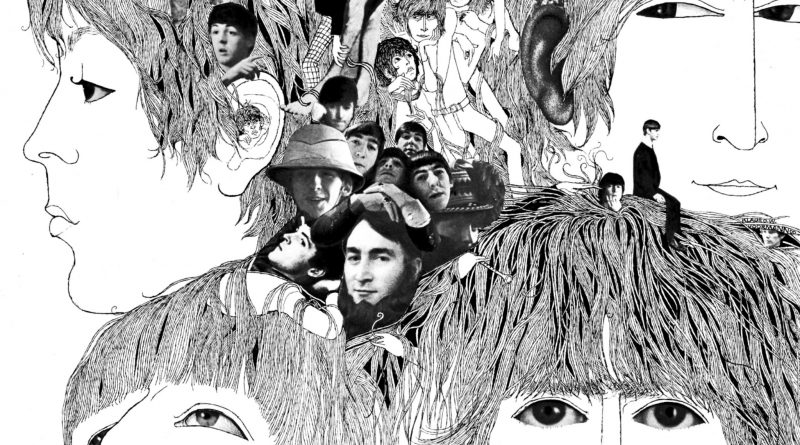
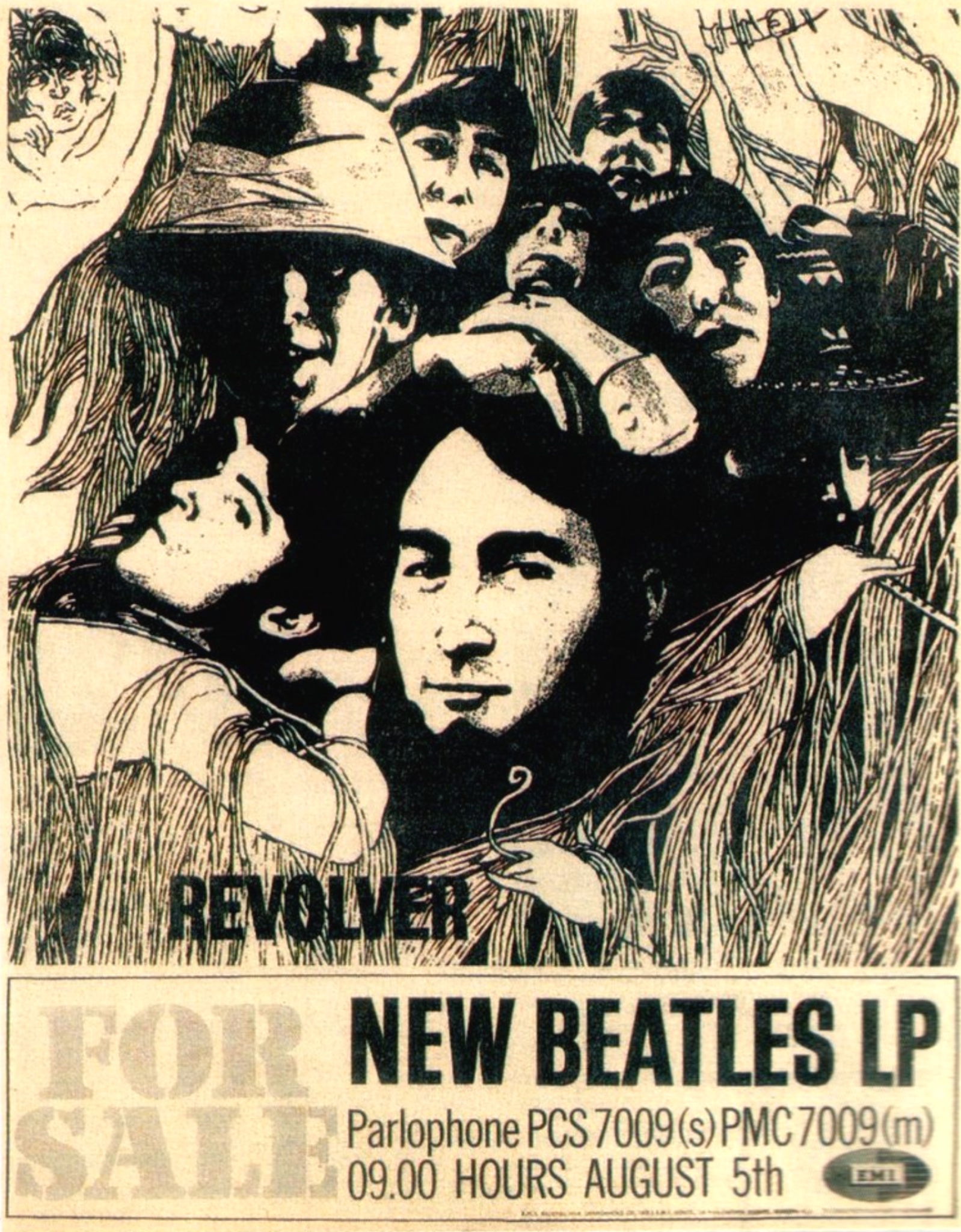
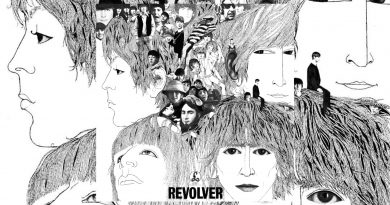
The classic album cover art began with a call from Lennon to Klaus Voorman asking him to take a shot at it. Voorman came up with a series of sketches in different mediums, which he brought to the band. They picked ones they liked as the idea turned into a collage with photos taken by Robert Freeman, as well as from personal photos.
It took about two weeks from start to finish, getting it to a point where the band and Voorman were pleased with the results, the artist even slipping a photo of himself into (in Harrison’s hair, prompting a laughing Lennon to say, “You cheeky bugger!”).
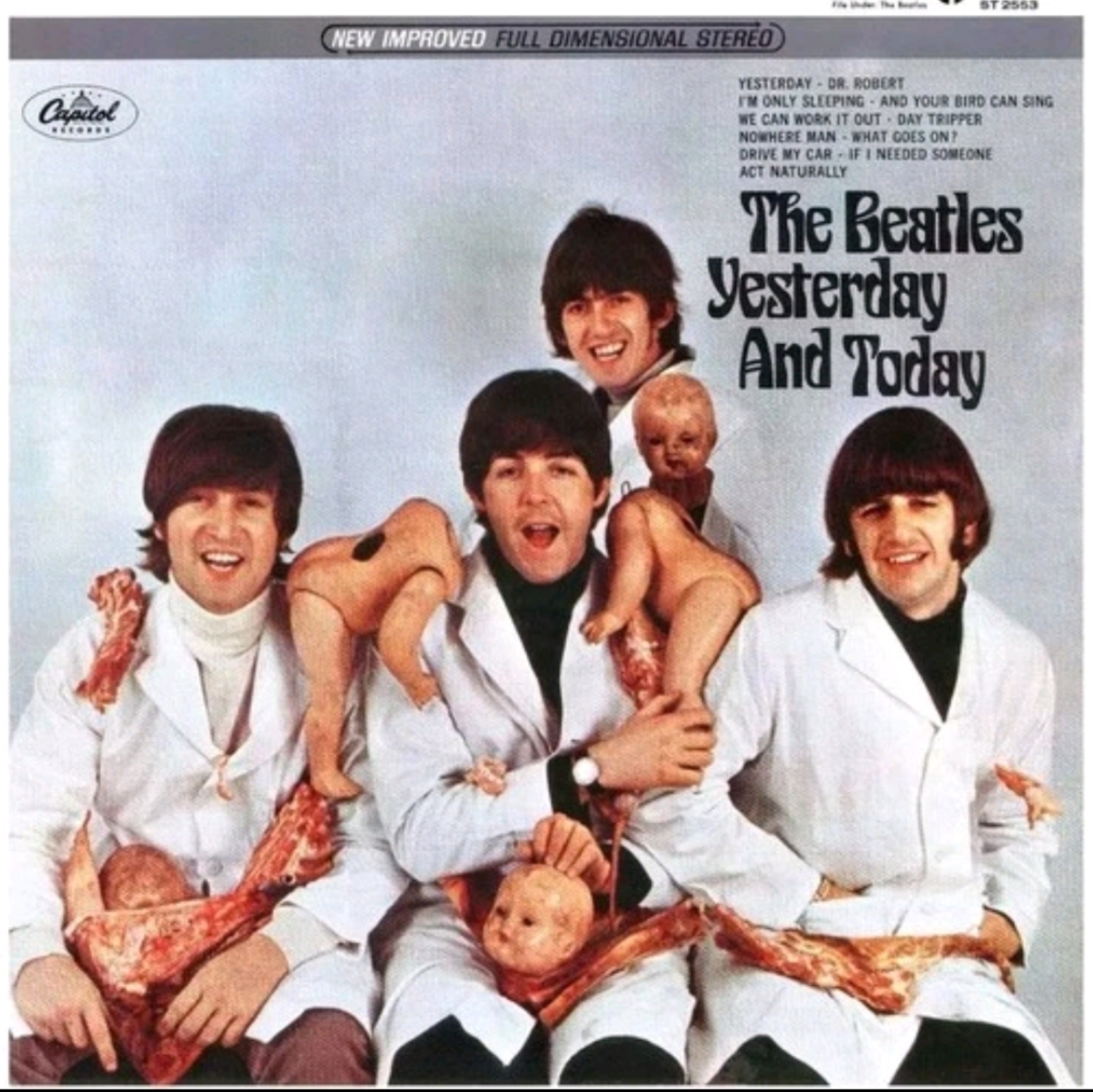
Revolver would be the last album given the indifferent hatchet job by Capitol in the U.S., which plucked “I’m Only Sleeping,” “Doctor Robert” and “And Your Bird Can Sing” off the as-yet unreleased album for inclusion on another hodgepodge — Yesterday And Today. That collection became known for its rare and notorious initial cover with the band in butcher smocks covered in raw meat and baby doll parts (which McCartney and Lennon insisted was a statement against the Vietnam War, although it could easily be interpreted as a shot at Capitol).
The band supported the album with its two short tours, although none of its songs were played, the only song from the sessions in the regular setlist being “Paperback Writer.” A chunk of Revolver material was, given the technical limitations of the time, not suitable for live performance. The rest? Well, the Beatles were mentally done with live performances even though they still had some dates to play out of contractual obligation.
The first series of shows went from West Germany to Japan to the Philippines, the latter an unpleasant mix of crossed wires (and appearance before the newly installed Marcos leadership that didn’t happen), angry responses from both pro- and anti-Marcos folks) and the band never getting paid for their shows there.
When asked about their plans for the next leg of shows, Harrison said, “We’re going to have a couple of weeks to recuperate before we go and get beaten up by the Americans.”
The experience exacerbated the band’s desire to step away from playing live, a grind of increasing unpleasantness of being too big, with a band unable to hear itself play.
A 19-day leg followed, even with John Lennon’s most infamous Beatles-era quote getting twisted by right-wing Christians.
In February, Lennon told a writer for the London Evening Standard, “Christianity will go. It will vanish and shrink. I needn’t argue about that; I’m right and I’ll be proved right. We’re more popular than Jesus now; I don’t know which will go first — rock ‘n’ roll or Christianity. Jesus was all right but his disciples were thick and ordinary. It’s them twisting it that ruins it for me.”
There was nary a whiff of a response when the article ran, but when a teen magazine picked it up and put part of the quote prominently on the cover in late July, the outrage machine cranked up in the Bible belt. Cue the record burnings and performative outrage from people who couldn’t read insisting that Lennon said the “Beatles were better than Jesus.”
Epstein offered promoters the chance to drop the shows, but no promoter was ignorant enough to lose a cash cow. Lennon offered a sincere apology for something he didn’t need to apologize for, which helped smooth things over enough.
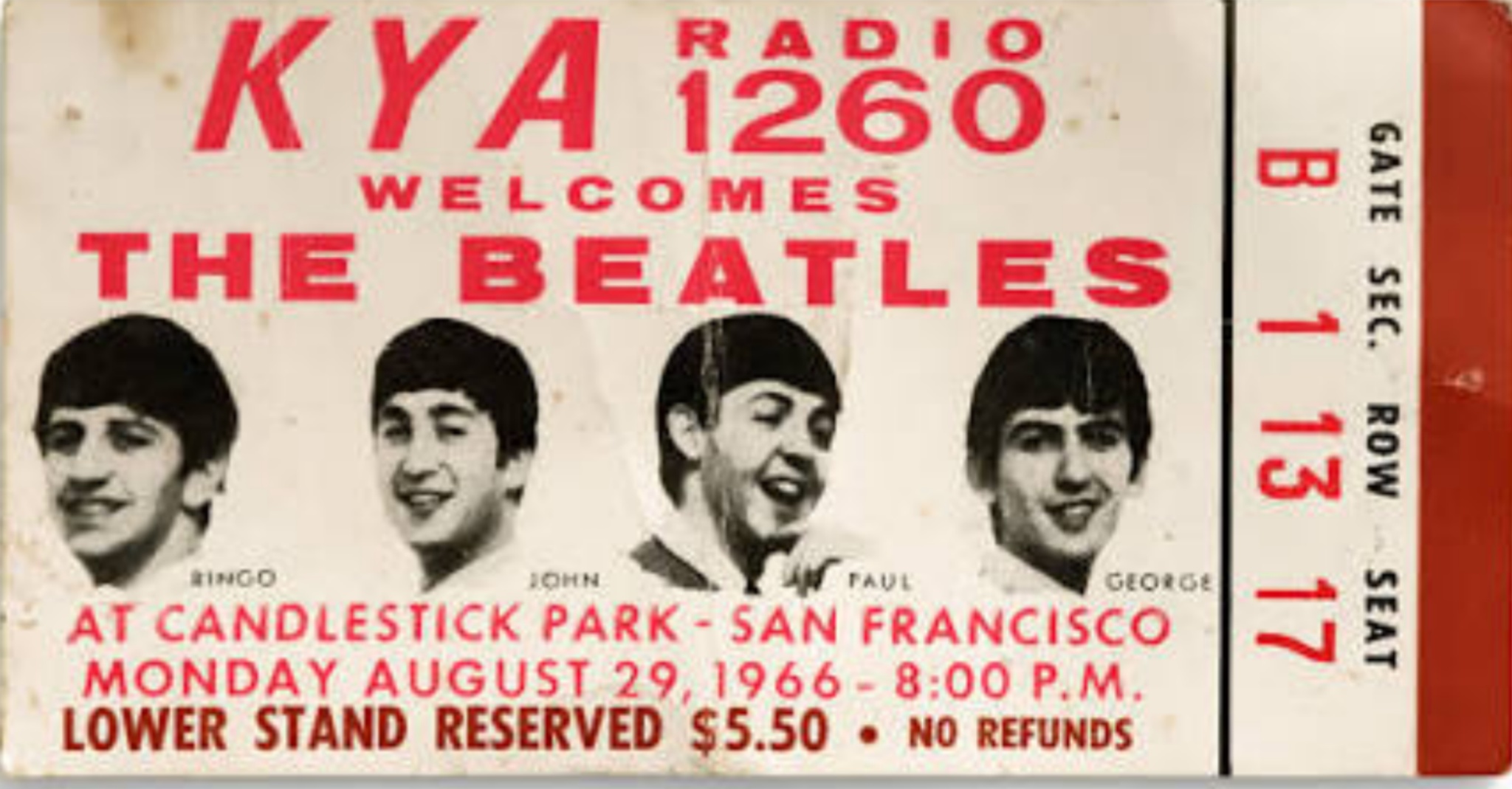
The band went through 17 shows in 19 days. By the time they left the stage at Candlestick Park on Aug. 29 (finishing an 11-song set with “Long Tall Sally”), they had zero interest in touring again.
In retrospect, one of the things that sticks about Revolver is how many ideas they crammed into short windows of time. The longest of the songs — “I’m Only Sleeping,” clocked in at 3:03.
The reality was that, in spite of the pot and acid, the drug that The Beatles were highest on was creative possibilities. If Rubber Soul was the sound of the band taking the studio for a test drive around the block, Revolver was the sound of them taking their new toy to the highway and exploring it for all it was worth with their three main songwriters firing on all cylinders.
It wasn’t just guitar, bass, drums, keyboards and assorted outside players, the studio itself at Abbey Road was as crucial an instrument as any other for them.
The Beatles effectively became a studio band with Revolver, but their official coming out as such, a concept album that wasn’t about a band that “Sgt. Pepper taught to play” was on the horizon.
If Rubber Soul heralded the new era of The Beatles, Revolver was where they fully claimed it — wonderfully poppy and yet deeply experimental, the Fabs as artists, not just craftsmen.
All in all, a much better use of their time than making a wacky western, especially when the result wasn’t just on the short list of best Beatles albums, but the best albums by anyone.

- Tomorrow Never Knows: The Beatles’ Revolver Turns 60 - July 20, 2026
- Here Today: The Beach Boys’ ‘Pet Sounds’ at 60 - May 16, 2026
- Manifest Density: Local H’s ‘As Good As Dead’ Turns 30 - April 30, 2026
You May Also Like
-
 February 7, 2024
 -
 October 18, 2022
 -


Great story. And Rain really is Ringo’s finest moment as a Beatle — just perfect.
You make a great point at the end about the time/expanding qualities of Revolver. One of the shocks delivered by getting it on CD was realizing how short the whole thing was. Creating an entire universe in just about 30 minutes is quite a feat!
The story is a great take on the Album and everything leading into it and around it. To this very day, I am mystified by EMI and its endless hard work at making its bands into crap. I am pretty sure if they had stepped aside, let the Beetles and the other bands ‘cook’ we might have gotten even better albums and more of them from the Beetles. Lord knows, back when they were playing we all needed the Beetles and all of the other bands were the only things keeping us sane during an unwanted war, civil strife, class inequality, environment under threat as well as extinction events, and…. *looks around, blinks* ….I’mma put on some Beetles and look for my Tie-Dyed t-shirts and my candy striped hiphuggers and start a sit in. Laters!
Thanks y’all. Nice site, great topics, top writers!