
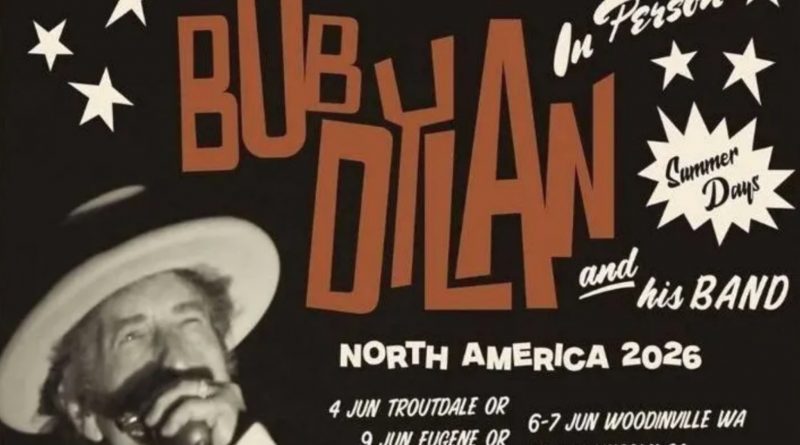
Bob Dylan Live 2026
The Bard paints a new masterpiece, just for us, every night
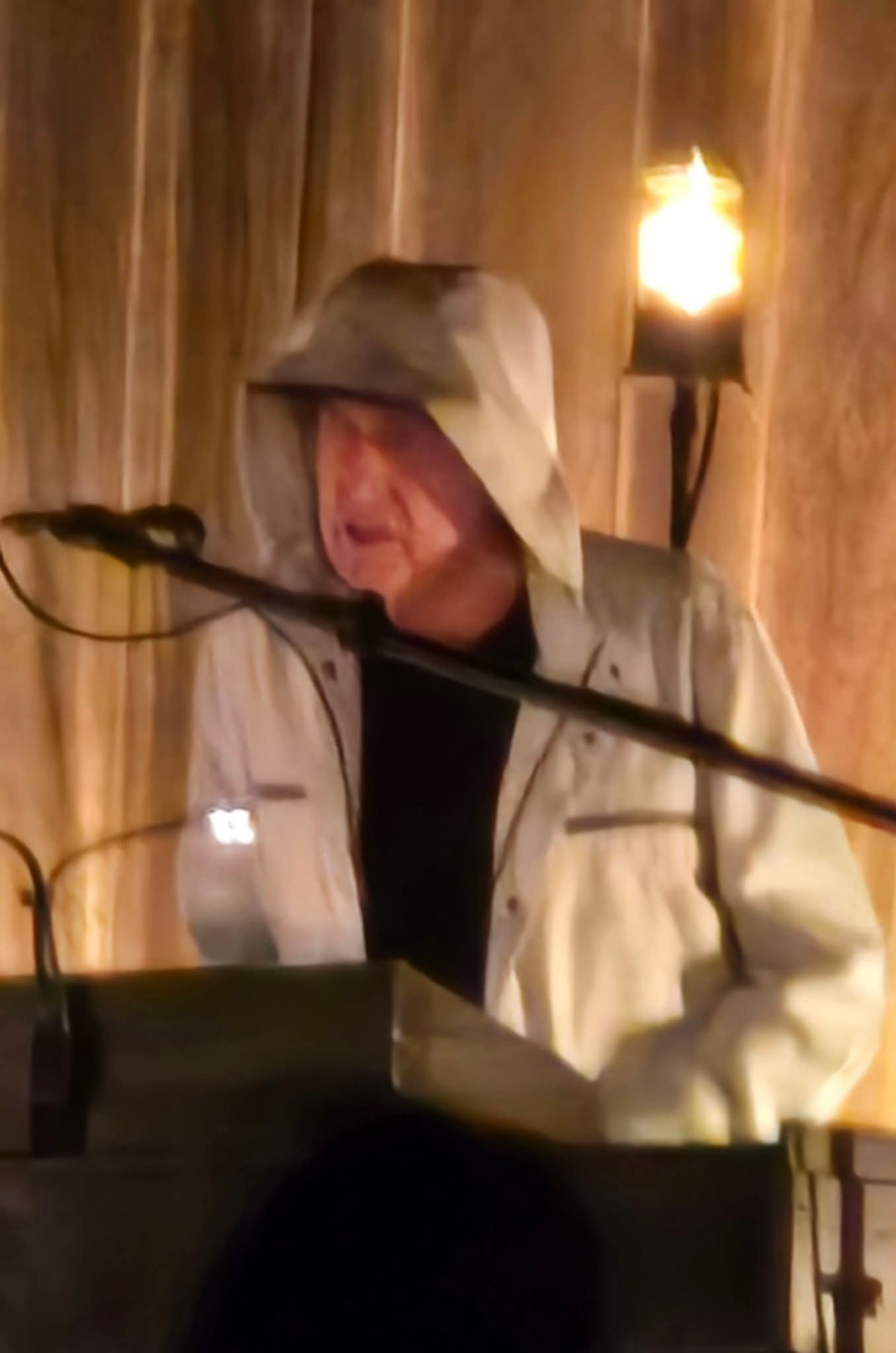
A few Sundays back, I went to the Hartford Healthcare Amphitheatre in Bridgeport, Connecticut and heard Bob Dylan play his greatest album, in its entirety.
It’s the album he creates every night.
It’s an album that exists only in a live setting, and likely only for the duration of a year or so.
It’s an album that says: “Why shouldn’t an artist do this? Why can’t an entire stage of a legendary artists’ artistic life exist just in performance, for a finite amount of time?” After all, what is more finite, more impermanent, more perfect that than a rock’n’roll room on one night only — the lightning and the soul’s eternal mumble and the bass frequencies lifting the floor and rattling the lights? Rock’n’roll, our pop era, was, after all, really nothing more than that feeling of the fever of the bass shakes and the Archangel on stage eyeballing the gilded door of the Satanic Mill making eye contact with YOU and the moment in the moment, the moment in the moment, the moment of hallelujah-cloud desperation reproduced sometimes on vinyl (after all I met the devil and Pet Sounds on the same night, but that’s another story), but mostly just in THE ROOM in the moment, babies, anything else was simulacrum.
So, in Bridgeport, Connecticut, on July 19, 2026, Bob Dylan played his greatest album, in its entirety. And if you see Bob Dylan in 2026 you won’t hear your favorite song. You will hear some songs you know, sung in a way that exists only for the duration of this artefact, this magical, magnificent album, called Bob Dylan Live 2026. And you will hear one of our lifetime’s greatest geniuses, singing for you, in the moment.
What I ask is: that an artist be present with us for an hour or so. Really present. Speaking to us, in the moment, as if he or she or they were telling a story to us for the first, and possibly only, time. What I ask is: That an artist not require us to measure them against their past, or make us afraid of our future. I want to be in the moment, with them, in the moment.
What I ask is: That an artist look me in the eye and heart and say, “I am In Delight with the sound I hear in my ears. Right now, this is my dream, my goal personal and artistic, at this time in my life. This is the music I hear in my head, when I seek to recover and uncover and remember and honor the spirits of the music that made me the person I am today. I give you this. Will you come with me?”
That is ALL Bob Dylan Live 2026.
The Dylan live experience requires you be very much in the moment, the sensory moment, the experience, the experiencing moment; this positions him as absolutely different than virtually any other legacy act (and most other performing acts, of any age). Like a friend playing you a favorite album or showing you a much-loved painting, Dylan wants you to attend (and if you don’t, well, at least he’s had an excuse to see his favorite painting again), he wants us to watch and listen with the dreamy yet wide eyes of someone falling in the thrall of a future treasured memory, NOT someone being asked to reference or cite a past memory. That is key to the Dylan 2026 experience. At this concert, no vocalist, no chorus, is being drowned out by a crowd singing along. How gorgeously rare is that? This is the thing: Have we, us sorry sad aging WE(s), become totally accustomed to our aging, legacy artists being human jukeboxes? Or is this what the artists expects of us, the audience? Is that how bloody low our mutual expectations are? Most legacy shows — even artists who came of age in the ’80s or ’90s, much less the ‘60s or ‘70s — are, essentially, singalongs, nicht was? You can hear it in your head, can’t you: A stadium full of the people screeching, “Don’t cryyyyy/Don’t raise your eyeeeee/It’s Only Teenage Wastelaaaand!!” My god, my god, this is the same band that created Quadrophenia, yet they have happily accepted the role of being your very, very high-priced karaoke machine. That’s disgusting. Disgusting. It says something horrifying about what our expectations are, and what the artist expects from us.
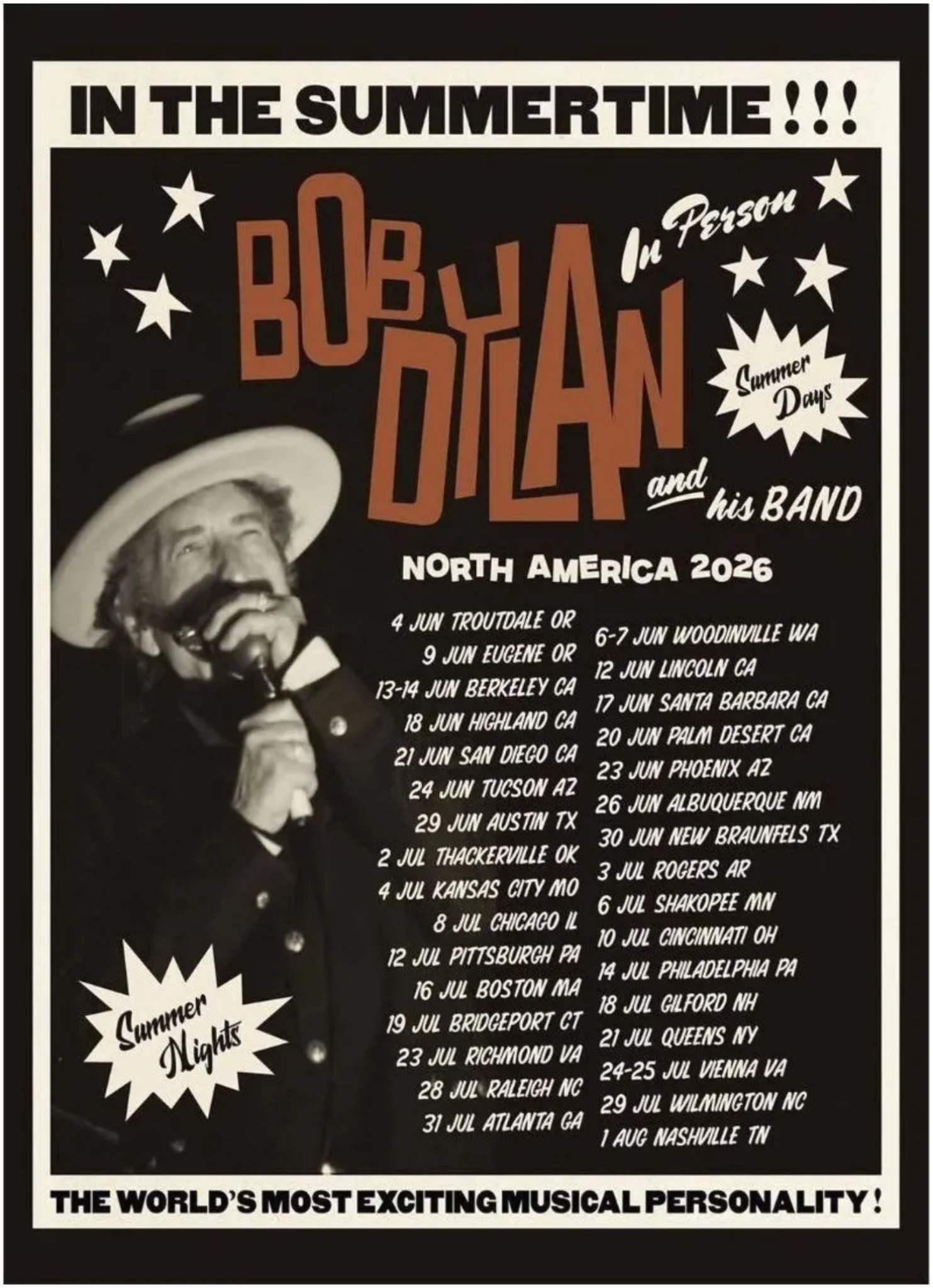
No one sings along at a Bob Dylan show.
We listen. He knows we are listening. That is because he is playing an album for us, a phenomenal album, that we cannot get anywhere else.
So very few major artists working outside the classical or jazz realm regards performance as its own wholly separate and rewarding (to artist and audience) box of their career. (Box – that feels right, but I really mean era, or period, or stage, right?) We do tend to think of our greater — or even lesser — artists in terms of the periods, and styles of their work; Beatles for Sale is distinct from Revolver, which is distinct from Abbey Road; everyone understands that. Murmur is different from Document which is different from Monster; and so on. It’s the reason, say, we don’t just refer to PiL, but to “Metal Box-era PiL” right? And, of course, we know Bob Dylan by his album eras, too (and if you’re reading this at all, it’s highly unlikely I need to delineate them).
But Dylan says: the way you would consider, parse, analyze a “New Bob Dylan album,” I want you to bring that level of anticipation and attention and glee and excitement into the concert hall, and I will honor that, yes I will. Do you remember how excited and attentive you were the first time you played Desire? Yes you do. SO sit your ass down on these seats and understand, THAT IS TONIGHT. You are about to hear the artifact Bob Dylan wishes to offer you in 2026, and you will only hear it in this room (or amphitheater, or whatnot. Who knew “amphitheater” had that beautiful little h in it, a chair for us to rest in on the way to completing a four-syllable word? I didn’t. It’s this sort of attention that Bob Dylan demands of us — see, friends, that little but huge ‘h’ brought me INTO THE MOMENT).
Bob Dylan 2026 is very different than the Dylans I saw earlier, only a few orbits of the sun ago. For instance, A 2018 performance of “Early Roman Kings” (at Symphony Hall in Springfield, Massachusetts) left me in the kind of puddled, mute frenzy that only Hawkwind, Hanoi Rocks or the Feelies have left me in; see, the George Recile/Charlie Sexton Dylan band was one of the greatest American rock bands I ever saw, period, translating the furious sparks and oil leaks of the Rolling Thunder band into a circa-1960 garage band context, New Orleans via Austin…and a year before that, I saw Dylan do an American songbook-heavy set at the Capitol Thee-ate-er in Portchester, where he prowled the front of the stage like a prosecutor, like a circus ringmaster, demanding you attend to his ownership — or at least his leasing — of these classic songs. On that evening at the Cap, Dylan said, almost literally (it was evident for anyone who was watching), “This is who I am now; this is ‘as’ Bob Dylan as Blood on the Tracks or Blonde on Blonde or Oh Mercy, I insisted on that then, I insist on this now. This is my heart, I am my own greatest listener.”
But Dylan 2026 is something else entirely; a kind of pulsing, spacious, hypnotic, southwestern spacerock, almost exactly between third album Velvet Underground and the Grateful Dead; one song sluices into the other, like a gorgeous, strange helium-filled car signaling and changing lanes on some long, low, western highway 44 minutes after sunset. In addition, I’ve never seen him so engaged with an audience: Not hiding from sight, Dylan stands upright at his piano, and he appeared to be looking straight out at the crowd, his face tilting and nodding with expression, grinning, lipping, communicating with pleasure, like a man living in and within his songs, and eager for us to take note; this was a very different Dylan than I had ever seen. Combined with the gorgeous, cottony southwestern-y sound of his band, it made for the most fully enjoyable and engaged Dylan performance I had ever seen. Honestly. I treasure that 80 minutes Bob Dylan spent with me, playing me the music he wanted to hear and the music he wanted to be in the summer of 2026.
And more on the sound itself: It reminded me of something gentle yet urgent and electric, a fully loaded caress, a perfectly balanced gyroscope; I kept on being reminded of third-album Velvets (or the thrumming, lazy/urgent sound of 69 Live), or even that extraordinary blend of low-end/folk art/American Weird R.E.M. created on the second and third album; and the headroom of the Dead is always nearby, and I mean literally the headroom, the way the Dead live sound created that illusion of infinite space hanging above the stage; that space is largely defined by the simple, very low-end round circles of bassist Tony Garnier and the unobtrusive, ultra-simple subtle yet urgent thump of drummer Anton Fig, whose absolute commitment to staying out of the way and also simultaneously playing incredibly straight with just the implication of a swing reminded me of two of my favorite drummers, Mick Fleetwood and Bobby Graham; and my GOD new guitarist Joel Paterson, Joel Paterson is flat out amazing, he sounds like an engaged, slightly weeded up middle eastern Bill Frissel, or maybe even Fred Frith, if that makes any damn sense at all, playing with space and intensity, and when married to the spot-on and I mean dead-fucking-spot on low-end soft-punch of Tony Garnier and Anton Fig, it’s a vaguely Dead-ish feel, only with a kind of no-wave/downtown intensity; throughout the set, Dylan constantly grins at Joel Paterson (who looks — and maybe even sounds a little? — like Eddie Cochran channeling Arto Lindsay), egging him on, letting him know when he hears something that especially pleases him, and oh the sound of this Dylan/Garnier/Figg/Patterson/Julian Lage band, mygod, imagine 6th Street/Frenchman Street firecrackers full of ellipses and long-spaces for sips of whiskey, yes that’s it, hah.
And It’s logical to ask: Why does he do this? Dylan is 85. He doesn’t need the money, he’s not trying to make up for bad divorces or crappy old publishing deals; He’s not seeking some myth of eternal, timeless youth, like Mick Jagger.
Bob Dylan is doing it because he is an artist. And he’s painting his masterpiece, every night.
AUDIO: Bob Dylan at Bridgeport, Connecticut 7-19-26

- Mitchell Cohen Sets the Story Straight - October 21, 2026
- Girlschool Release 1981 Reading Set - October 5, 2026
- Bob Dylan Live 2026 - August 1, 2026
You May Also Like
-
 May 24, 2019
 -
 August 26, 2018
 -
 June 21, 2026
probably the best Dylan concert “review” ive read. you totally got it.
cheers Timmy!
That’s it, mate !
I agree with Geoff Gans, great writing!
I loved this post, helped me understand my mild (?) obsession with catching Bob live and got me even more excited about the two albums I’ll be catching experiencing in Denmark and London before the end of the year, many thanks for the post
You only hope that he’s recording these shows for a future where we will not have him.