
Mad About Professor and the Madman
New album, ‘Dreamworld,’ out now
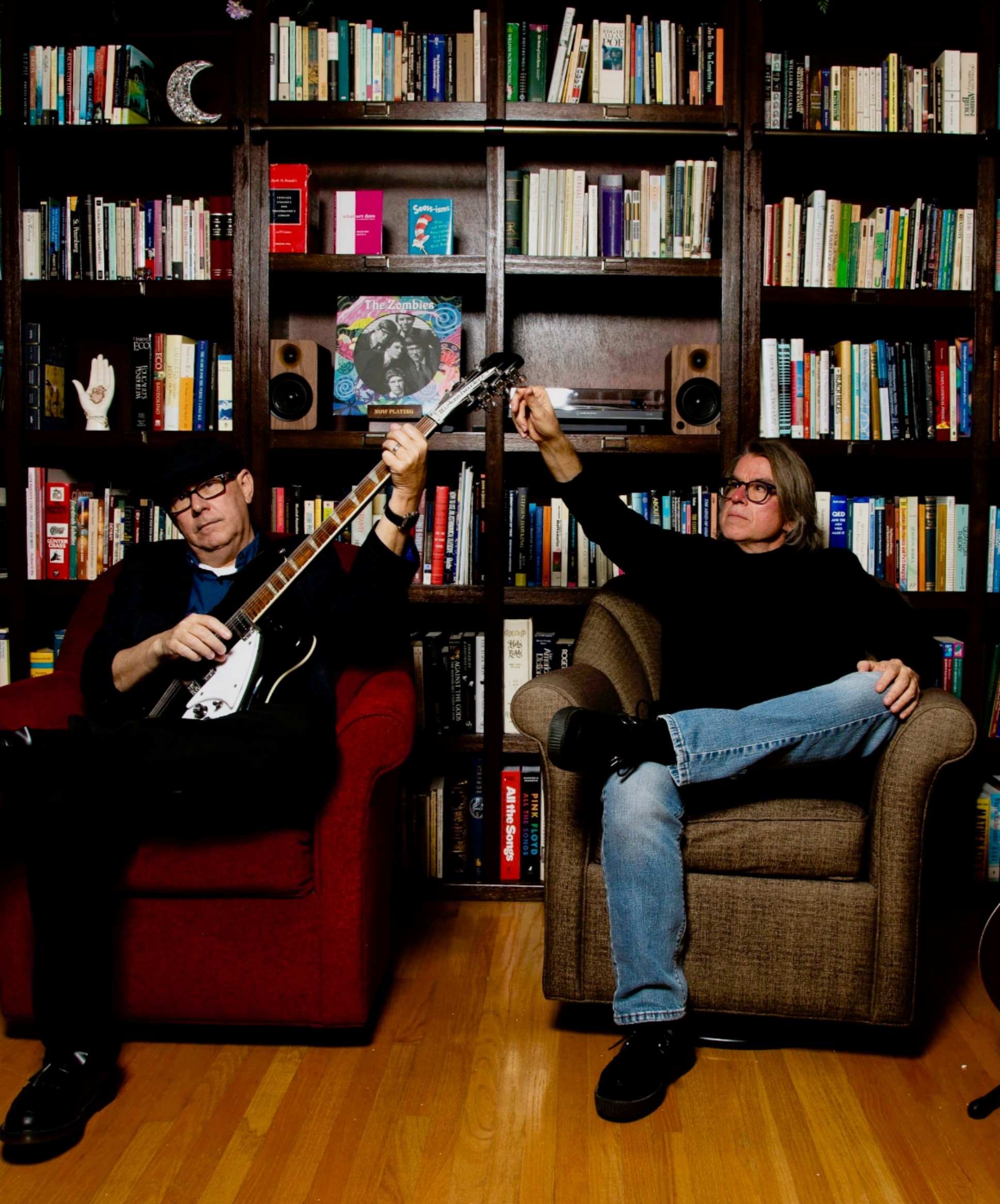
Professor and the Madman is primarily a duo, but occasionally a group.
Formed in 2015 by co-frontmen and multi-instrumentalists Alfie Agnew (an actual college professor) and Sean Elliott (a purported madman), PATM provides them with a creative outlet far removed from their high-pressure daily lives. Alfie is a tenured mathematics professor and researcher at Cal-State Fullerton while Sean is the CEO of a modular home manufacturing company.
To coincide with their fourth studio album, 2020’s well-received Séance, Professor and the Madman played a handful of live shows, including a date at the 100 Club in London. So far, this UK gig has been the only public performance to feature PATM’s illustrious rhythm section of Rat Scabies (drums) and Paul Gray (bass). Scabies has played on every album while Gray has played on the last three.
Up until their brand new LP Dreamworld (out Aug. 7), PATM’s albums were completed via file sharing. Agnew and Elliott in Southern California would digitally send demos to Scabies and Gray in the UK, who would record their parts and return them. Dreamworld marks the first time that all four members had the chance to record together simultaneously in the same room. They spent a very busy — and productive — day at Abbey Road Studio 2 in August 2024.
No live shows are planned in support of Dreamworld. As you are likely aware, Scabies and Gray are busy for the remainder of the year with concert commitments celebrating the Damned’s 50th anniversary.
Rock & Roll Globe last spoke with Agnew when j. poet interviewed him to coincide with the release of Séance. You can read that interview HERE.
We recently had the chance to catch up with Agnew and Elliott. Dreamworld is available today on LP, CD, 8-Track tape (!) and download at Bandcamp.
By the early 1990s, your punk careers converged and you were both touring stateside — as well as internationally — as guitarists in the SoCal punk band D.I. I imagine that you both grew up listening to a wide range of music. At what point did you realize that you wanted to flex your musical muscles outside the domain of punk rock?
ALFIE: My brother Rikk, 10 years my senior and a vast consumer of different music, was responsible for my musical education. It started as a toddler in the early 1970s with a heavy dose of Beatles, Hendrix, Kinks, Beach Boys and others. Hard rock and prog bands gradually took center stage, from ELP to Deep Purple and beyond. I really took to all these genres. They were my foundation, along with jazz standards, mariachiand Irish folk music (from my parents).
Rikk first drew my attention to punk rock in 1976. However, it wasn’t until around 1981-1985 that I went through a “punk/hardcore only” phase. I started writing music regularly during this period.
By 1985, I was already drifting back into power pop, rock and the more complex harmonic composition present in my earlier influences. I always had side bands that weren’t punk after 1985.
SEAN: I have always played whatever I thought sounded cool. In the early ‘80s, I was in a local band called the Critens and we played “Pipeline” (the Chantays), “California Über Alles’ (Dead Kennedys), “India” (Psychedelic Furs) and “Storm the Embassy” (Stray Cats). So, I never felt handcuffed to punk rock. I thought it was Punk Rock to draw from a wide range of influences, but I’ve since been set straight by the real punks from the ‘90s (implied sarcasm).

Dreamworld is your fifth studio album with Rat Scabies, and your third with Paul Gray. As lifelong fans of the Damned, do you have to pinch yourselves every day regarding your good luck? What is it like working with them?
ALFIE: For sure. One of the first albums Rikk turned me onto was the first Damned album. Then, of course, The Black Album won me over for good. They are a band that just kept getting more interesting. I love all their stuff.
Working with Paul and Rat is a pleasure, because it is effortless and high quality at the same time. They are very talented musically, not just at their instruments. So, their interpretations of the music Sean and I write add a lot of value to the compositions. Moreover, they are great people.
Dreamworld is further evidence that you are both musical omnivores. It’s got jaunty pop reminiscent of Supertramp (“Brave New World,” “Dreamworld”), power pop (“Tolerant World), a cocktail jazz interlude (“Mental Tape”), grungy hard rock (“Temple of Madness”), self-reflective piano ballads (“Songs in My Head”), and an energetic pop-punk cover (20/20’s “Nuclear Boy”). When you start a project, do you intentionally go for a wide gamut of styles, or does it just evolve that way?
ALFIE: It evolves that way. Both Sean and I have a wide range of styles and influences, and we’re not afraid to show it. We write a lot of music. When we set to work on a project, it’s usually a combination of material we are currently working on and excited about, surrounded by unreleased compositions that turn that material into a coherent whole. The gold standard of this approach is Sgt. Pepper’s. We don’t think in terms of a collection of singles like the earlier Beatles LPs. That’s probably the prog influence.
SEAN: We just go for it. We have our own home studio, and nobody is telling us what we can or can’t do. If it sounds cool, we record it.
In 2024, you were able to pull together enough funds to travel to London and record at Abbey Road Studio 2. I understand that you only spent one day there, alongside Rat and Paul. How many hours did you end up having? I assume that you knew exactly what you wanted to accomplish. After overcoming your awe at being in that room, how much pressure did you feel to get your money’s worth?
ALFIE: Yes, it was one marathon 10 or 12-hour session. I don’t recall the exact number. We had three songs we wanted to be sure to get done, and, of course, a good chunk of time was spent getting the sounds right and tightening up everything. I was in awe.
Abbey Road produced arguably my top two favorite bands: The Beatles and Pink Floyd. I grew up seeing pictures and videos of those guys working there. We had a first-class engineer directing the session, Paul Pritchard, and he helped us soak it all in.
I was less worried about getting my money’s worth than making sure I did the space justice. It was immense pressure, but the kind that brings the best out of you. It was a great success in my opinion! I’ve never sang or played harder.
From the lyrics on this album, your “dreamworld” is intrinsically linked with your adolescence. “Adams Street” is an especially beautiful remembrance from Alfie about the street on which he grew up. On “The Light,” Alfie asks, “Who took the light out of your eyes?,” perhaps referencing a loss of innocence. While Sean takes centerstage on the album’s epic first single, “12 Strings and Tambourines,” which refers to the moon landing as a future event, and its accompanying video has quick video snippets of the Beach Boys, the Byrds, and the Rolling Stones, among others. Is surrendering to middle age a total bummer?
ALFIE: Surrendering to middle age is not a bummer for me, though I really love the past and prefer certain aspects of it. If you’ve done it right, transitioning to middle age becomes more of a rotation of advantages and disadvantages.
The remembrances in the lyrics are joyful but honest. I grew up in the working class but fairly idyllic Southern California suburb of Fullerton. It wasn’t perfect, but I had a lot of magical times. “Adams Street” summarizes that, going from the sweetness and naïveté of youth to the more serious, yet exciting, march toward adulthood. The music reflects that exactly. With “The Light,” it is a melancholy reflection of the pivotal, sorrowful events that adults experience. Events that those around you, if not yourself, experience.
Life is intense, and music is very cathartic. Much of the music I’ve written has been angry, melancholic, sad, or downright morbid! In spite of how that may appear, I love life and highly recommend it. Perhaps I get all the negative out of my system through the music.
AUDIO: Professor and the Madman “12 Strings
Sean, was your day job as a modular homes manufacturer the starting point for “Brave New World”? (“The problem with building things we’ve never seen/You Never know what’s wrong or right/We’re out of time—we’ve got to pull it together”).
SEAN: Not at all. That song actually started from a sci-fi idea. It’s about aliens from the future trying to save a dying Earth by building a new planet, but they run out of time. They are so far advanced, but they still end up getting things just a little bit wrong.
Alfie, you are currently a tenured Professor of Mathematics at Cal-State Fullerton. How does your daily study of gravitational wave physics, Quantum field theory in curved spacetimes, and Mathematical cosmology affect your songwriting?
ALFIE: Both the mathematics research and the songwriting involve a tremendous amount of creativity and imagination. That synergy has strengthened my “creativity muscle” to the benefit of both. Sometimes it’s less abstract than that: One song I wrote around the same time as other Dreamworld songs is called “Atmosphere,” which has a Ray Bradbury sci-fi thing going on. It was completely inspired by my interest in space.
“Songs in My Head” will doubtless resonate with fellow musicians. It addresses the mystery of the songwriting process, even featuring the manifestation of a muse who “glides down the stairs” and is “just as beautiful as the day we first met.” Is songwriting your most rewarding escape from the 9-to-5 grind? Is it difficult to come to terms with all the song ideas that won’t make it to the recording process?
ALFIE: Yes, it is definitely the most rewarding escape. Fortunately, I like my 9-5 work, but, for better or worse, my mind needs to rotate among a few lofty endeavors to be content.
SEAN: I don’t think it’s difficult to come to terms with ideas that didn’t make the final cut. An album’s personality usually reveals itself during the demo phase, and the songs that fit usually are included. Those that don’t might be on a different album. “The Light” has been on the list for four albums. “Brave New World” was originally intended to be the closing track on Séance, but it had a similar vibe to that album’s “Time Machine,” so we left it off.
What’s next for Professor and the Madman?
SEAN: I think it’s time for us to do our Orange County punk album, circa 1980.

- Mad About Professor and the Madman - August 7, 2026
- The Art School Abandon of San Francisco Punks The Mutants - August 30, 2022
- Downtown 81: Tav Falco Recounts East Village Adventures - August 19, 2022
You May Also Like
-
 December 12, 2020
-
 December 13, 2020
-
 March 14, 2020
