
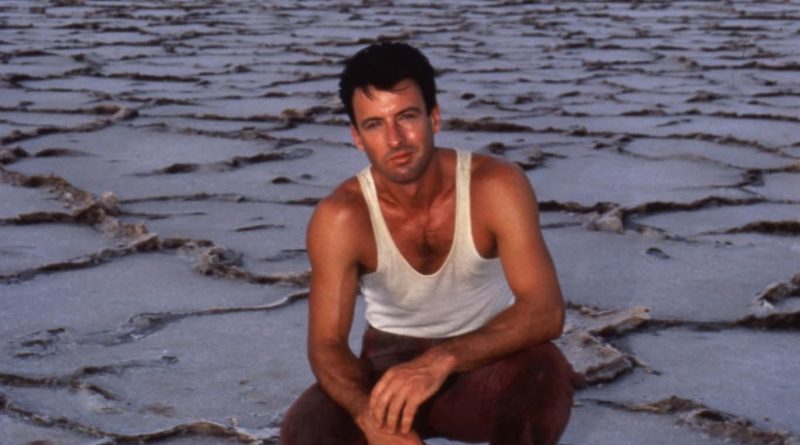
Rob Hirst Was the Engine of Midnight Oil
Remembering the Australian band’s drummer and songwriter

Cancer sucks, all of it, but they say pancreatic cancer is the most painful, the worst.
And after a three-year battle, that’s what took the life of Midnight Oil drummer/songwriter Rob Hirst on Jan. 20th.
“Rob is now free of pain — ‘a glimmer of tiny light in the wilderness,’” his bandmates posted to Midnight Oil’s social media channels, quoting the Oils’ song “A Hundred Years or More”. “He died peacefully, surrounded by loved ones. The family asks that anyone wanting to honour Rob donate to @pankind_australia or @supportact.”
The phrase in the interior quote is borrowed, one surmises, from the Oil’s “King of the Mountain” and the lyric about “walking through dry grass and a mountain in the shadow of light.”
Although songwriting input came from all five musicians, and singer Peter Garrett handled the bulk of the lyrics, Hirst and guitarist Jim Moginie were the principal composers. In his memoir, Moginie described Hirst as the “engine room, onstage and off. Rob was brash, funny and super intelligent, contrary to the clichéd view of drummers.”
I saw and reviewed Midnight Oil lots over the years and did various interviews, mostly with Garrett — as eloquent and persuasive as a speaker as he was powerful as a front-man. But in 1990, I did a joint interview with Peter and Rob, and was very happy to get Rob’s take in the Oily mix.
Hirst had attended a Bruce Springsteen concert with an American friend in Madison Square Garden a few years ago and, for some reason, that’s where the conversation began.
“It wasn’t the best Springsteen concert,” said Hirst, “so we got to talking and he turned to me — this is really strange from an Australian point of view — and said (adopting an Southern U.S. accent), ‘You know, with the Oils there’s politics and, you know, there’s righteous indignation and there’s, you know, all that stuff that Pete does, but basically, I think you’re just one hell of a kick-ass good rock ‘n’ roll band!’ “
“I nearly fell over!” said Hirst, laughing at the recollection. “‘Yeah, that’s what I think it is, too.”
What makes the situation humorous is the fact that Midnight Oil is rarely described in those terms. Despite the group’s ability to craft memorable melodies, to rock out fiercely — and to create a cathartic, meaningful bond with its audience — writers often key on one side of Midnight Oil: The political side. (I’d probably been guilty of that.)
Not that Hirst disagrees with the politics of the Oils. In fact, after he agreed with his American friend, he added, “There’s quite a bit of the other as well.” And, the “other,” of course, is the politically-oriented sensibility that’s been the backbone of the band since its inception in 1977.
But these were Hirst’s thoughts on the musical process which produces their trademark sharp, stinging melodic hooks. “I think that’s something we even forget as well — the writing of good pop songs and rock songs. I think that area is really the common denominator, still, and sometimes forgotten. You’ve got a group of musicians that like writing songs and playing on stage and I think that’s really where it begins and ends.”
Well, he didn’t really think it ended there, but Hirst was obviously pleased at the chance to discuss the music itself. It can be fairly stated: No one is going to listen to any political song, no matter how trenchant, if it doesn’t have other attractive elements.
“On tour in 1988,” Hirst said, “we just got very bored on the bus so we started writing, Jim at one end of the bus with his guitar and myself at the other end of the bus with a little Casio I bought at an Indiana truck stop for $75. We worked toward song writing in a different way. I can’t play the guitar, but Jim and [co-guitarist] Martin [Rotsey] play very well.
“I seem to have some sort of knack for God-given melodies and lyrics and rhythms, so we meet half-way. Most of the better-known Oils stuff, I suppose, was created with me bringing stuff to Jim and vice-versa or collaboration, in which the band contributes and Peter adds or subtracts lyrics.”
Back to Garrett, who checked in on the phone from another locale, and picked up a core band theme. “Environmentalism has been there before the dawn of time in Midnight Oil history,” he said. “We’ve looked up and seen our beaches have gotten polluted and we’ve played our Greenpeace benefits like a good environmentally-conscious rock band would. I’m being kind of funny about it, but obviously we’re serious about it and we’ve done it for a long time.”
“It’s difficult to quantify,” said Hirst, “but we feel like we’re doing our small bit.”
VIDEO: Midnight Oil “Forgotten Years”
Audiences seemed to agree. Blue Sky Mining, Midnight Oil’s seventh album, had gone gold (signifying sales of more than 500,000 copies) and the band had graduated from clubs to theaters to outdoor arenas.
Hirst and Moginie formed Midnight Oil when they were at college in Sydney. The band spent seven years building a rabid following in its homeland before attempting to conquer the rest of the world. In 1984, the band released its fourth album and its first U.S. effort, 10,9,8,7,6,5,4,3,2,1, which was accompanied by an avalanche of hype, including a cover story in Musician magazine with a fierce photo of Garrett on the cover.
“I think we were the biggest band in America never to have sold a record,” said Hirst, with a chuckle.
“It’s funny to think of too — much-too-soon for a band like us — we’ve always been very cautious and gone the hardest route — but maybe it was,” said Hirst. “I think that we were with people [an agency] that were keying for us to be the next overnight sensation. But, as we all know, good things take a while to develop and we’re much happier to do it this way.”
Blue Sky Mining is more atmospheric and textured, less thematically specific than some previous records.
‘We describe it as sort of the Instamatic record,” said Garrett, “like snapshots. It derives in part from the traveling that was done and the experiences that people had looking out the window and being in different places when we did the Diesel tour.”
One of the best songs, though, “Forgotten Years,” was inspired from thoughts about World War I. Sings Garrett: “Our sons need never be soldiers/Our daughters will never need guns/These are the years between/These are the years that were hard fought and won . . . Who can remember? /We’ve got to remember! . . .
“The hardest years, the darkest years/Forsaking aching breaking years/The time ‘n’ tested heartbreak years/These should not be forgotten years.”
Midnight Oil shot the video in a cemetery in Verdun, France, the final resting place for many war dead. “We thought it was the best place to illustrate the song,” said Hirst. “The song is a song of peace, not war. This was supposed to be the war that would end all wars and, of course, that wasn’t the case.”
How did the Oils work together?
“We politely debate each other through gritted teeth,” Garrett said, with a laugh. “It’s volatile from the inside, but it’s not something we talk about a great deal.”
Added Hirst: “It’s not so much friction as constant debate and discussion.”
Of Garrett’s intense, sweat-drenched performances in concert, the singer said, “If the music is sufficiently sliding, swinging and pumping along for me, I’m reasonably content to get the songs done and try and have a good time when I’m up there. I’m just trying to maximize my moment, my brief cosmic moment.”
Blue Sky Mining is a textured, layered album — certainly less full-throttle than the band is in concert. “I think what happened,” said Hirst, “is that quite a larger percentage of songs we chose out of the 16 or 17 we’d written were more atmospheric.”
VIDEO: Midnight Oil “Blue Sky Mine”
But when you see them, expect the Oils to burn on higher intensity in concert. “We love to drive hard,” said Garrett.
Added Hirst: “I heard the tapes we did at Wembley two nights ago and, believe me, it’s pretty rough and raw, so in spite of some nice production by Warne Livesey on Blue Sky Mining and the other records, certainly there’s a fair bit of grit and attack on stage, to which you’ll no doubt see in Boston.”
So, who is Midnight Oil?
“It’s a collective entity,” Garrett said, “but it also has room for people to individually put their stamp on it. It’s fortunate that it’s got more than one source. It’s trying, in its own very insignificant small, slightly angry-shouting way to lift the scales off everybody’s eyes including its own. Go out and knock the barbarians out of the seats and claim the earth for the people.”
“Six people who are vastly over-educated,” said Hirst, with a laugh.
***
In the fall of 2021, Midnight Oil announced its effective retirement following the death of bassist Bones Hillman. They wrapped in up Nov. 3, 2022, with a concert with Sydney.
Hirst is survived by his wife, Lesley Holland, and daughters Gabriella, Lex, and Jay.
I’ll give the last word to my friend, Gang of Four drummer Hugo Burnham: “He was damn good.”

- St. Vincent Goes to the Symphony - June 10, 2026
- A Decade Without Prince - April 21, 2026
- Rob Hirst Was the Engine of Midnight Oil - January 23, 2026
You May Also Like
-
 February 3, 2021
 -
 August 22, 2022
 -
 October 30, 2023

Pingback:Rob Hirst, Midnight Oil Drummer, Dies at 70 - AussieWatch.net