

Jennifer Finch on the ’90s Alt-Rock Scene
‘It was the last era of true innocent rock’
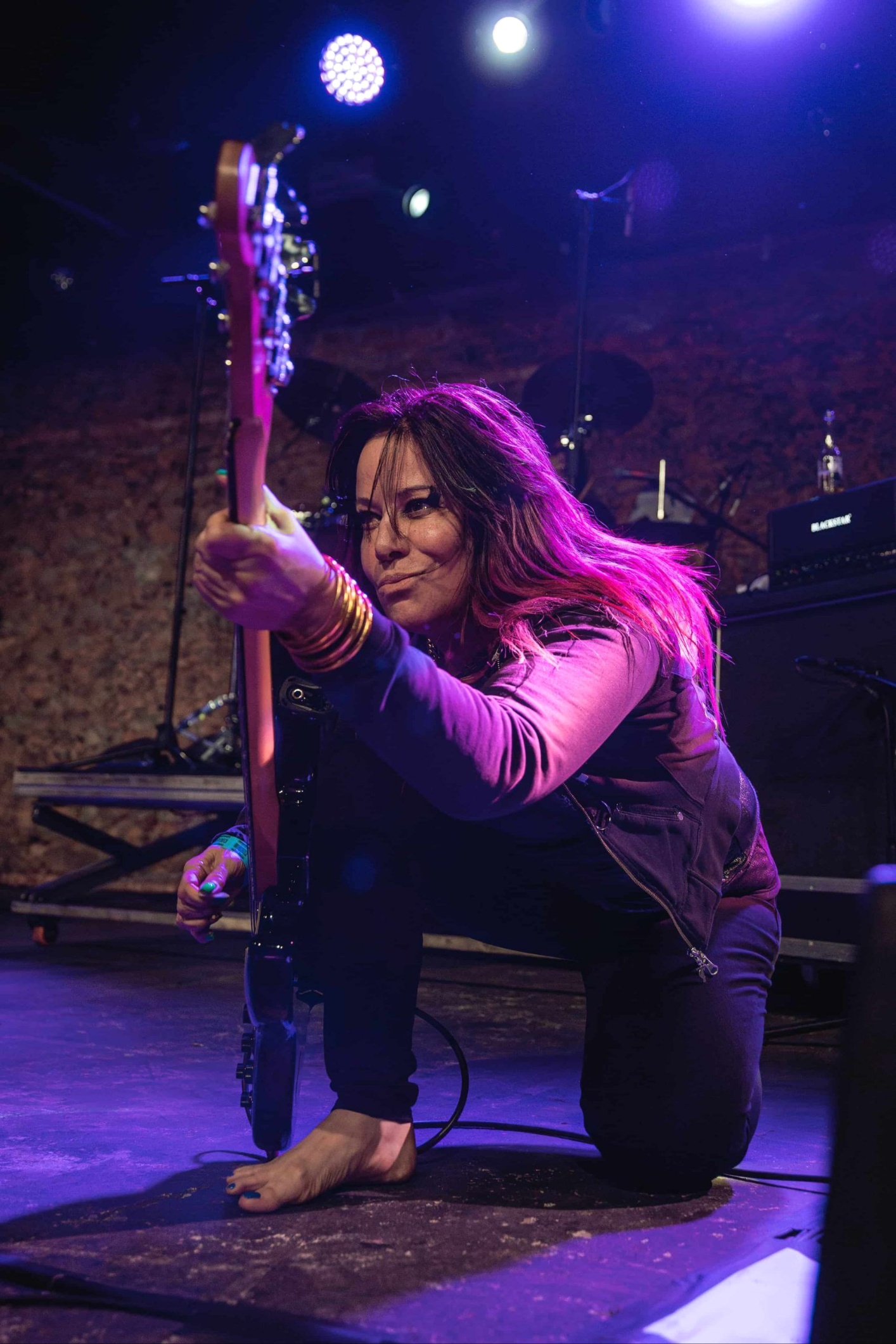
Fans had barely taken in the news that Jennifer Finch, bassist with alternative rock band L7, was dealing with aggressive brain cancer, when there was a sad follow up: the announcement of her death this past Saturday, July 18. She was 59 years old.
Finch will always be best known for her work with L7, who released four albums between 1988 and 1994, and a reunion album, Scatter the Rats in 2019. Their peak period coincided with the rise of grunge, and, despite being LA-based, the band had plenty of connections with that scene, recording Smell the Magic for Sub Pop and going on a UK tour with Nirvana in the fall of 1990. When I played the band’s “Fast and Frightening” while guesting on a radio show hosted by Nirvana bassist Krist Novoselic, we both pushed back at the band’s being lumped into a generic “women in rock” category. They weren’t “women in rock,” Krist observed — “They just rock!”
I spoke with Jennifer in 2011, for my book Entertain Us: The Rise of Nirvana. Though the interview was Nirvana-focused she had plenty of interesting things to say about the indie rock years of the late 20th century, and some good observations about how the internet would up end things in the 21st century.
When did you first hear about the Sub Pop scene going on in Seattle?
Courtney Love was a friend of mine. She got a job in a record store in Portland, Oregon, and one Christmas sent me a pack of different releases that were out, a couple singles from Sub Pop, and said, “You’ve gotta get up here. This is the only scene happening right now in America.” She’d just been to Minneapolis, and had lived in Los Angeles. And I agreed with her.
Later, when we recorded Smell the Magic, I moved to Seattle for about a year. I stayed on Capitol Hill, with Danny Bland [of Cat Butt], and Kelly Canary [of Dickless] and everybody. All in a big house.
Were there any shows of Seattle bands you saw during your stay that stand out for you?
Seven-Year Bitch. All the usual cast of characters. I got to see everybody. I mean, I’m like the quintessential tourist of the grunge scene! I just fell right into it, at the right year, and got to see everything! Cat Butt was always one of my favorite bands to see live. I don’t remember actually seeing any big touring acts, though. I think it was just going to the bar, and there were good shows!
We first met Nirvana in Seattle. My memories of Kurt [Cobain] early on, he was very energetic and well-spoken, and that’s what kind of declined over the years. He became much more withdrawn and shy, and less communicative. When we first met them it was at Sub Pop, we all met them in this alley and they had their van and we just hung out, and it was just fun. It was an immediate click, like the humor was the same and the sarcasm was the same. The views on music were the same. It was like a natural click.
I first saw them as a band in Los Angeles. Their energy and style of music and everything was what I’d dreamed about my whole life. I grew up in LA hardcore, and it became such a mechanical feel to LA hardcore at a certain point in the early ’80s that you just abandoned it. It felt like not having any kind of community at all from ’85 to’87, ’88. And then [with bands like Nirvana] it was really like — I’ve heard Donita [Sparks, L7’s guitarist and lead singer] say in interviews — we’ve found our tribe. And it wasn’t in our own city.
Nirvana was down here in 1990 talking to record companies; they were staying at my house. I went with Kurt to talk to Capitol. There was just this boom rush of how many grunge acts major labels could sign, even at that point. But it was interesting to see how he operated. I think maybe a lot of people don’t realize that he was very professional in that capacity. He wasn’t just a “I don’t care. Whatever.” He had very specific questions that he wanted to ask, he was interested in what the compromises would be and had an understanding of how everything worked, the sort of mechanical side of the record industry.
The meetings were really just about dinner and I want to say “schmoozing,” but that’s such an overused word. More like entertainment, and to show the power of the record company. And then they get to buy everyone dinner. The assumption is an artist is gonna sell out their entire career for a six-pack, so you take ’em out to dinner and get ’em a six-pack!
So you were there to get the dinner?
I guess I was there to get the dinner! I wish I went to the really significant meetings. I don’t even remember if they met with Warner Brothers at that point, ’cause that would have been an interesting one to be a fly on the wall for. But definitely the Interscope one would’ve been a good one to be a fly on the wall for.
What did you think seeing them with Dave [Grohl]?
I knew Dave before, when he was in Scream. I used to book Scream. I was a booking agent, so that’s how I knew those guys. I loved Scream. And my early memory of Nirvana bringing in Dave was, it was kind of like a professional choice. It seemed to me like they were getting this young hotshot in. I thought, “Oh, they’re selling out, trading in a member” you know. [laughs]
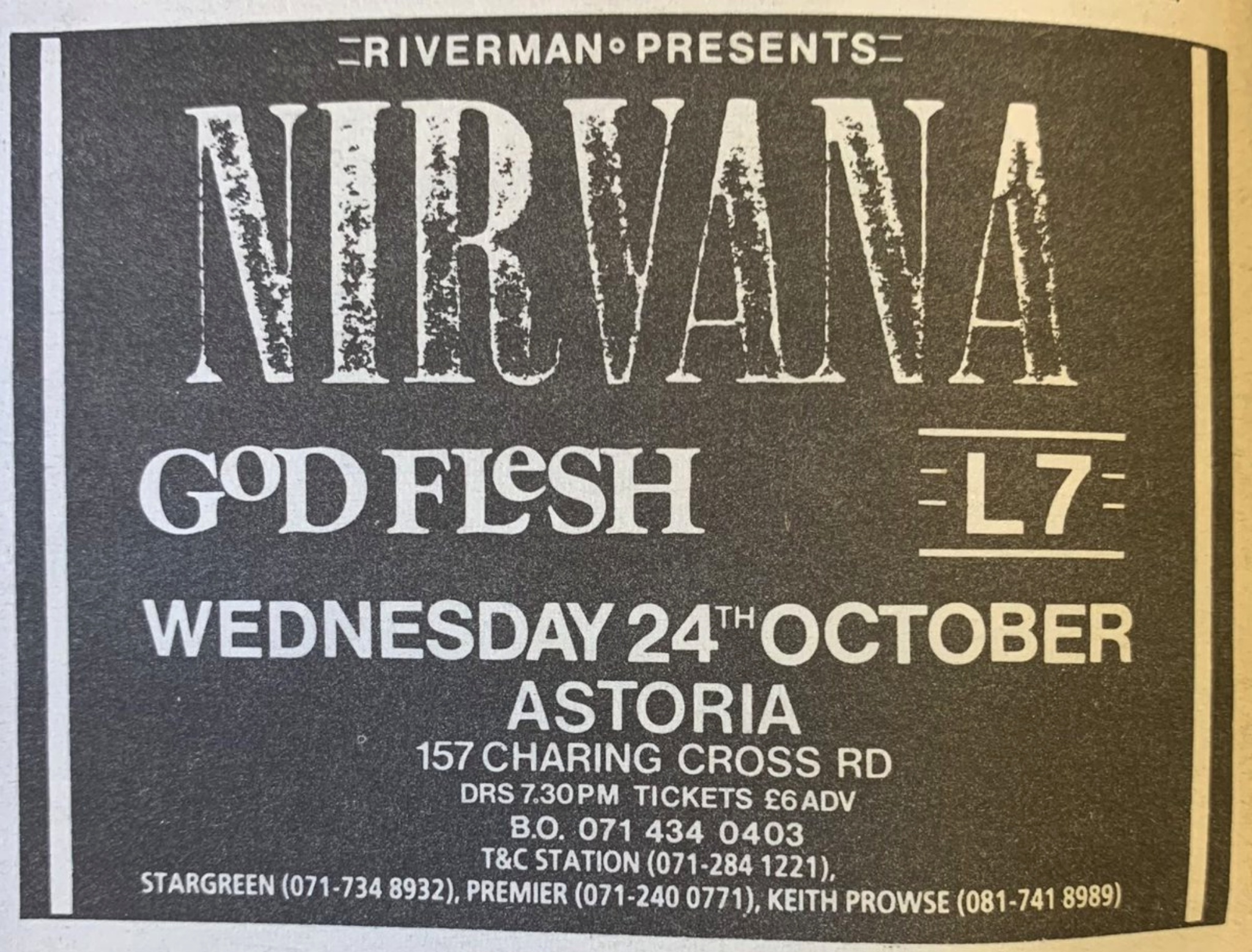
Tell me about the 1990 UK tour with Nirvana.
Dave and I started going out on that tour. There was just like a great wild energy. The shows with Nirvana were our first larger shows and playing in front of a larger audience, and it was just mind-blowing how many people would even be interested! I mean, that’s all I can think. L7 always did well in smaller clubs, like the [LA club] Raji’s style, pack 120 people into a 70-person space. We always did incredibly well with all that stuff. But then to really expand it out where there was a barrier in front of us — I think it was one of the first times we’d played in front of a barrier.
Were you thinking that Nirvana was going to go on to something bigger?
Not at that point. At that point, I never really thought it would be as big as it has gotten. I never saw it in that kind of perspective when I was younger. I never thought that way. I just didn’t have the ability to think like that, I’m a very day-at-a-time kind of person, in general. Because if I did think that way, I would’ve married Dave, and I would be living in a house on a hill!
With a pool.
With a pool! Yeah! Exactly! If I thought like that.
Did they talk to you about signing with a major, if that was something they wanted to do? Or is that selling out?
I don’t remember conversations ever being involved with selling out because I think that the major record labels at that point were really trying to present themselves as being artist friendly. So the real question was: are you exchanging money for losing your career? That was more of what was discussed. And the band that completely paved the way for it at that time was Sonic Youth. I mean, they were one of the first alt scene/indie bands that went and did sign with the major label and they had a great experience with it. So there wasn’t, at that point, any example of bands from our scene that had a bad experience.
Did I ever tell you this story — I can’t even remember what I’ve talked to you about before — when I saw Mudhoney and Nirvana back-to-back? I was just like, “Mudhoney’s gonna make it. They’re more commercial.” You could tell that they were gonna move more in a commercial direction. But Nirvana’s just too weird. Sonically, they’re just too weird. I mean, I loved them, but I never thought they would ever turn it out the way they did. I thought they’d be as big as Sonic Youth. And to me, that was total success. If you could run a career like the Cramps or Sonic Youth, that was the goal! [laughs] See, I don’t know what I was thinking! Too bad. I’d have my house on the hill. But there’s never any reason to change any kind of music style, to sell out as a writer, because there were tons of musicians that already had complete total success outside of a major machine.
What did you think of Nevermind’s songs before the album was released?
I thought they were good songs, but I didn’t understand how “Teen Spirit” could ever become as popular as it was, with the energy of the song really leading the song, and not a vocal melody leading the song, or lyrics leading the song. I love when bands use energy and zeal to lead the listener. I mean, I listen to deep stoner rock now which has no lyrics, or very minimal lyrics. I’m a complete fan of that. But as far as something that’s gonna get played at the Superbowl or whatever….
What about when you first saw the “Teen Spirit” video?
I thought it was great. But again, it felt like, no one is ever gonna like this. It’s too weird and cool! It had too much of a vision! What are they gonna do with it? It’s gonna go on 120 Minutes [MTV’s indie rock show], because we know people who are on 120 Minutes. And Headbanger’s Ball [MTV’s metal show] isn’t gonna touch it. You know what I mean? And then, all this money is going into it, and how’s that gonna get recouped? And I just didn’t think much of it!
VIDEO: Nirvana “Smells Like Teen Spirit”
You also played the Reading show with Nirvana in 1992. That must have been one of your biggest shows ever.
At that point, yeah. I have a diary dedicated to that show. With lots of photos. I wonder if I can find it? You’d think I’d be more prepared! You think you could just come to LA and do this in my living room? Cause all of these books and stuff are in here. I have all of their setlists, and our setlists, and photographs of them all together. That was definitely a huge show for both bands. They had always done well in England, from the second they set foot in there, because of [journalist] Everett True’s interest in them, and media interest and gossip kind of interest. It was always fun to hang out with them, because there’s always crazy controversy. We all stayed at the London Astoria, the hotel, and it was just such a party; I think Krist [Novoselic] broke a plant that night, in the lobby. It was great.
Every memory of that is so well-documented. Like Everett bringing Kurt out in a wheelchair, and mud flying. Nick Cave was great that night. A friend of ours from Los Angeles had recently passed away — the singer from Blind Melon, Shannon [Hoon] — and his band, Blind Melon, were at Reading for some reason, so it was nice to see them, but very sad. Mudhoney was there. It was just fun! It was like a class reunion.
What is it do you think that makes Nirvana’s music last?
Well, the thing is, I don’t think really that their music will completely last. I think that — but in a good way — because I think that they really represented an era, of not just music history, but history in general, and sentiment like that may actually be lost in 30 years, 50 years. People today can still enjoy it just because it still reflects a kind of angst or feelings that people still have, but I also think a lot of younger people have moved on to not really looking back so much at Nirvana, and have invented their own heroes for that kind of stuff. But, you know, people my age are still buying music, so we’re still gonna replace our Nirvana records or turn it up when it comes on the radio.
I don’t know if I’m being cynical, but I feel like it was the last era of true innocent rock. I think it was the last era where you had to do it because you loved it. Because it couldn’t be a career choice. Any right-minded kid that wanted to have a house and have a family knew that they couldn’t become a musician. It was the last era of the true starving musician, so you had musicians that were in it absolutely because they were either crazy, in denial, or just truly had a passion for what they were doing, and were willing to make sacrifices in their lives to get it. Everything after that, anyone after that, any alternative scene, could actually make a viable living out of being a musician. Until now. Now it’s a little bit different. Now it comes back to the record companies are falling apart. Everyone is just like, “It’s so terrible being a musician.” I’m like, “This will produce, in the next five years, the best era we’ve ever seen of musicians, because it’s gonna eliminate the pros.” It’s gonna eliminate the pros. If you want to be in a band, you have to do it because you love it, or you’re willing to pay for your band to go on tour, or you’re willing to pay to have your record put out, just like it’s always been, where you’re gonna have benefactors, people that believe in you, who aren’t in it because they’re gonna make a profit. And we’re gonna start to see that again. That’s my prediction. I’m happy the internet ruined everything! I think we’ll probably get some good music again.
You have to be willing to be open-source. Nothing is proprietary anymore, which I think is one of the original bases for music, you share it. That’s what it’s for. There’s copyright. But something about music, growing up, is making a cassette for your friends and sharing it. You shared it. That’s how we found out: Courtney sent me records. She shared them. We share music. So it’s kind of weird now. You just go online, you have all this access, and it’s interesting. It’s an interesting way to look at all this stuff. You’re actually making music for free. You have to share it. You don’t have a choice.
One last thing. Were you at the Club Lingerie show in 1993 where Kurt and Courtney did a short duet together?
I didn’t see that. I’d remember that. I don’t remember being at that show. Really, I could’ve been. I mean, I could have seen Courtney go to the stage and been like, “Oh, this again,” and then went out and smoked a cigarette. [laughs] It wasn’t like, “Oh my God, a moment in history! I really should be witnessing this!”
VIDEO: L7 “Fast and Frightening”
VIDEO: L7 “Stadium West”

entertainment and travel.
- Jennifer Finch on the ’90s Alt-Rock Scene - July 24, 2026
- Rock & Roll Globe’s Best Rock Books of 2025 - December 26, 2025
- ‘Never Turn Back’ and the Lasting Power of Music - June 22, 2025
You May Also Like
-
 December 12, 2023
 -
 February 13, 2020
 -
 February 9, 2026
