
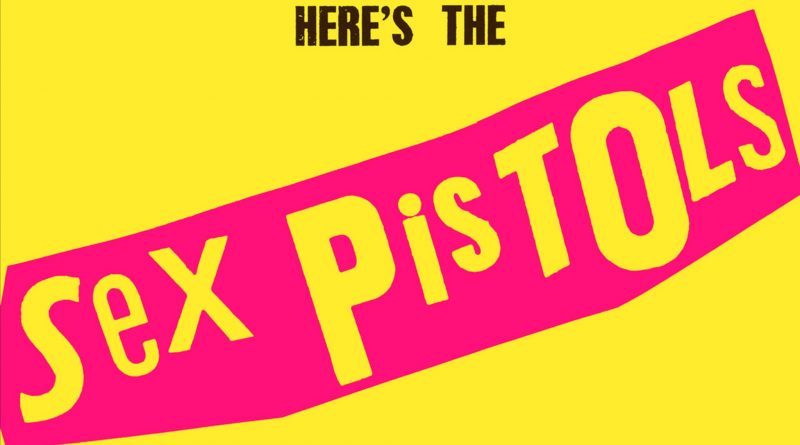
Get Pissed: The Sex Pistols Turn 50
Exactly half a century ago, England’s punk godfathers split the Earth and raised the flag
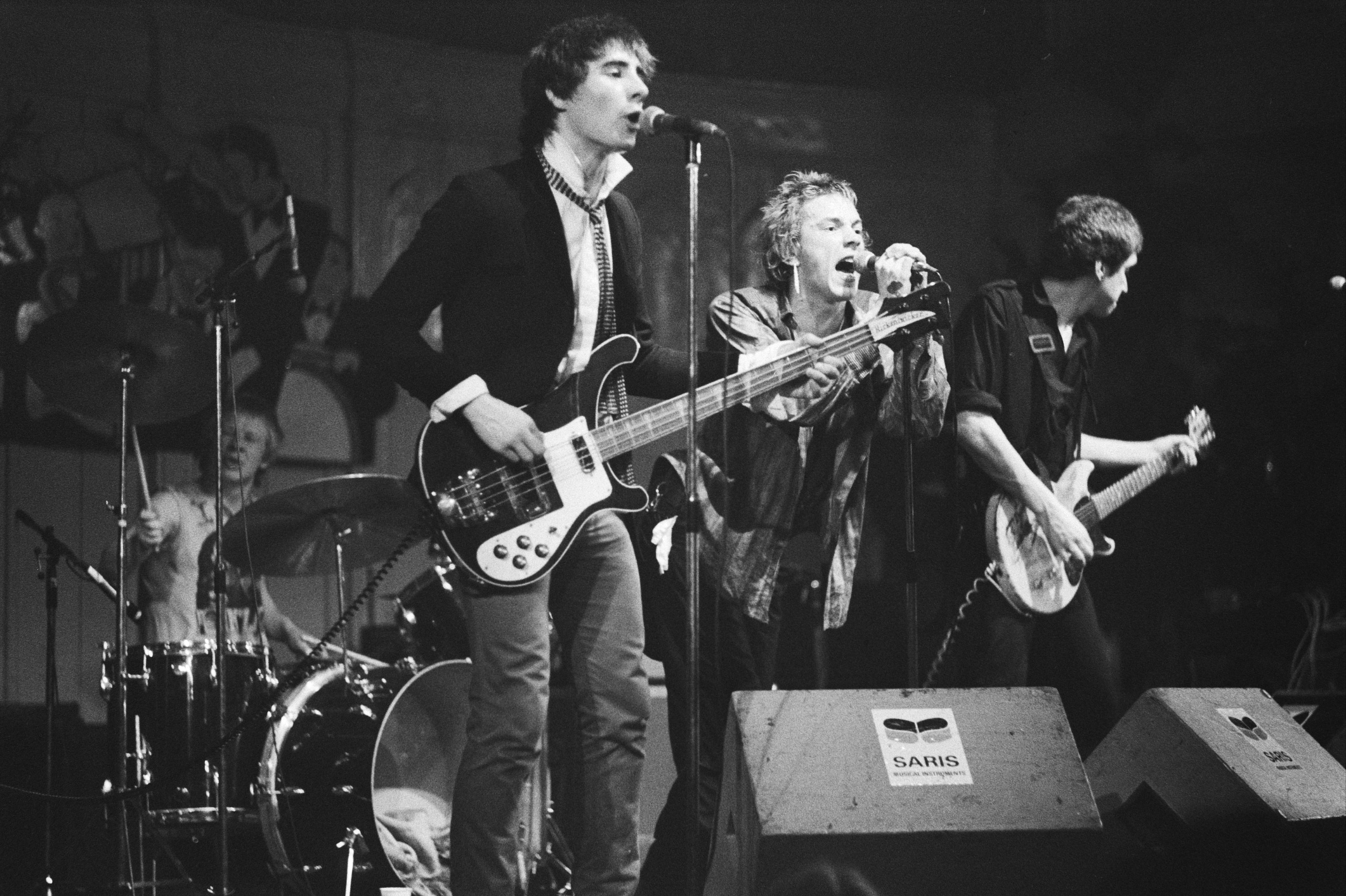
The Sex Pistols played their very first gig 50 years ago, on Nov. 6, 1975, at St. Martin’s School of Art and Design in London.
This was a crack in the face of culture. It was the Now and Then, moment of Us and Them we had been looking for.
And if you are 14 years old in 1976 and not looking for the moment, the invitation to Us and Them, well, then you’re probably not reading this.
Yes. We.
You are 13, 14, 15, maybe 16.
It is 1975, 1976, 1977.
You think: There are things in this world that are almost mine. Yes, almost mine. Things that almost belong to me. I see glimpses of myself in things that happened when I was eight, ten or twelve; in music that was made by people ten or fifteen years older than me. They speak to me, even if they speak at me. I squeeze every drop out of these glimpses, I live on them. They sustain me in these times of Kansas and England Dan-ism. Taurkus my ASS.
These things that are almost mine are important to me, but they are not mine. They speak to me, but they are not mine.
Then: The Sex Pistols. The Sex Pistols were ours.
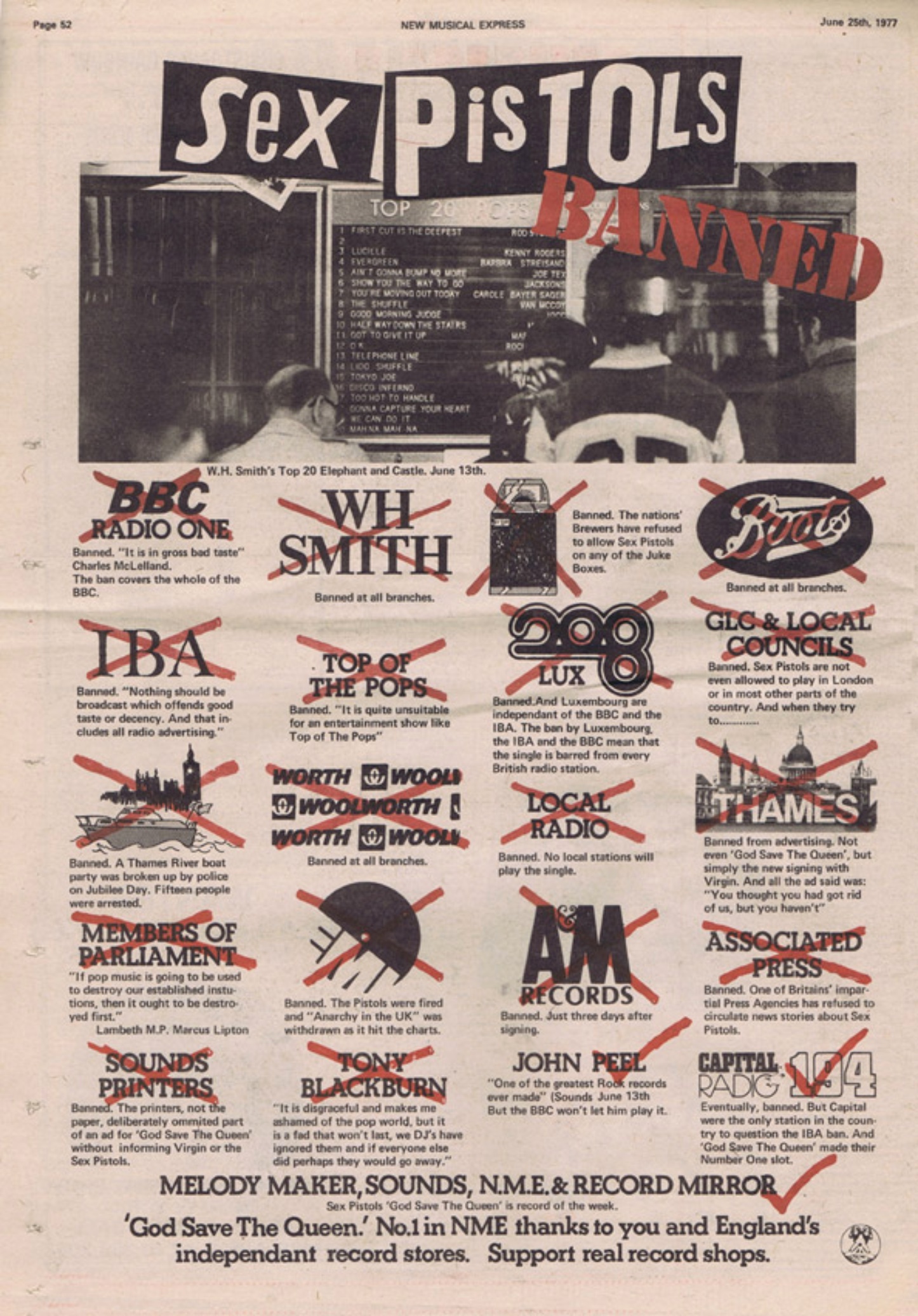
Of course, bands had played punk rock, or something very goddamn close to it, before the Sex Pistols. The Ramones, undoubtedly, not to mention the Saints or Dr Feelgood, predated them. But these bands did not create seismic generational divides. (No, not even the Ramones; although they were, inarguably, the purest of the punk rock bands – and their first album is punk rock’s single greatest and most perfect artistic statement – the contemporary reach of the Ramones was relatively, if not severely, limited, both culturally and in terms of sales/audience; and they did not shake an entire nation’s sense of style the way the Sex Pistols would. The Ramones would sell a million t-shirts in the 1990s and beyond, and hundreds in the 1970s.) But what of all the feral, louche and loud precursors, Troggs and Stooges and on and on, oh, far too many to detail? Ah, but a precursor is a firecracker in the sky, not a match that sets off an entire movement. Elements of style, not style itself! Exceptions to a rule, not a rule so frightening to the establishment that they refuse to put the name of the song in the charts. See, before the Sex Pistols, there was a rumor of rain; for a long time, there had even been thunder in the distance; but the Sex Pistols were the lightning that lit the sky, and in the flash of light, a flag was raised, as no other artist had been quite able to.
After all: No movement, no artist, no band, no song, no guitar chord, no soaring sigh or scream of a chorus vocal, is more important than what it means to the listener. The power of music is defined by its’ effect on us. This is the atmosphere it exists in; ‘us’ is the air that music requires in order to breathe. This power, the very reason music exists daily, hourly in our hearts, heads, houses, and cars, is defined by how it – the music, the song, the stance, the style — makes us excited to be alive in the era when this noise is created; it is defined by how it (the music, the song, the stance, the style) can be used as a mnemonic, a pin in the map of life, to create a marker which allows us to remember, ‘This is who we were, what we were, where we were when we heard this song.’
As importantly, perhaps more importantly, music allows us to find our tribe: a song, a band, even a t-shirt, is a flare we can send up to find people who might be our friends, who may be enchanted by the same things that romanced, stunned, or moved us. How many friends have you found through a song, a band, a t-shirt, a logo written on the back of a notebook?!?
And the Sex Pistols: We knew them immediately, because they were ours. They were not inherited from an older sibling (like those scarred copies of The White Album or The Freewheelin’ Bob Dylan); they were not ten or fifteen years older than us, or slathered with a saucy, strange sexuality that we could barely understand when we hardly knew our own, like Bowie or Johansen; they were not gods who roamed stadiums at a hundred yards’ distance, like Plant or Page or Iommi; and nor were they weighed down by a blues tradition whose deep, actually profound inheritance we could not yet grasp. The Sex Pistols were ours, the first revolt of fear and joy and style that belonged to us and that we discovered first (or maybe some friend exactly our age did); they were not second-hand, ever-so-slightly handed down rumors of yippies or hippies or glamsters (even if we fell in love with these things, we always, always knew they were not ours, and adopting their style would always feel like an affectation, or even a hand me down). And we all immediately knew that the Sex Pistols — and what they stood for — belonged to us as no other band had. You will understand this if you were there (that is, if you were 13, 14, 15, 16): The Sex Pistols, and the whole movement that seemed to spring from them, were frightening, startling, even threatening (like sex was in the years when it was a rumor, an unknown!).
Oh, it’s true, the Sex Pistols, even glimpsed in pictures, were exciting/frightening, in just the way sex was when it was a mysterious, creepy, creeping, obsessional unknown. We were experiencing, FOR OURSELVES, finally, four OURSELVES, what we had read the Who or the Kinks had felt like in ’64, or the glorious dirty/clean erotic confusion the Beatles had summoned in ’63. It was our turn! We, who were still thrilled to find ourselves awake on a school night when Tom Snyder came on, were absolutely rocketed and riveted with curiosity when we found a band that could frighten us and that was OURS. The Sex Pistols were the name that made our budding romance with music real, because they allowed us to take ownership of our place in the world of noise and culture. The Sex Pistols instantly felt like the potential for our late-night future, unveiled.
VIDEO: The Sex Pistols “God Save The Queen”
Nov. 6, 1975, may have been the moment, the instant, the Sex Pistols emerged on stage; but for at least a year or so, for those of us here in the United States, they were an exotic, remarkable rumor. And just the rumor, really, and a few pictures, was enough to begin to draw that line in the sand, to give us the sense that something revolting and tantalizing and magical, like our older brothers and sisters might have experienced, was finally ours (only we were immediately convinced it was better than anything they could have possibly experienced). Even a few pictures, a few rumors, a film clip here and there, announced: The flag had been flown.
The flag that was raised on Nov. 6, 1975, fifty whole years ago, a whole half century ago, fifty whole years ago, a whole half century ago, came to define so much of my life. It was a revolt of style and sound that felt like it belonged to me, as no other movement until that moment had. True: I would not hear the name ‘the Sex Pistols’ for another six months, and I don’t think I heard any music for a year. But Nov. 6, 1975 is the day they — they — THEY — Johnny Rotten, Steve Jones, Paul Cook and Glen Matlock — stepped on stage as the Sex Pistols for the first time, and Nov. 6, 1975 is the day that whatever was out there, floating around in the fumes of the counter-cultures I was spelunking in my acute virginal haze of “I know I’m different I’m just not sure how or where my tribe is,” became Ours, Our Generation, My Generation.”
Yes, of course, I had been investigating; I had been searching, without knowing exactly what I was searching for; I had sensed the rumor of rain, and I was on some kind of trail: whether it was the Kinks or Phil Ochs (whose blend of anger and poetry I had fallen deeply in the thrall of); Lance Loud or Quentin Crisp (because there was something so utterly powerful about the middle finger on the limp wrist!); Kinky Friedman or Leon Redbone, with their strange antique romance; Blue Öyster Cult, Thin Lizzy or the MC5 (because the smart dumb riff will save us all, dontcha know); and mygod Python and the Goons (the rebellion of brilliant nonsense!). I had been looking, looking, looking for flags, and in all the right places, too. But then, someone in London flew a flag far, far higher, and that flag spoke very specifically to me, and said, this is YOURS, this is YOUR GENERATION. And that was the Sex Pistols, who were born fifty years ago on November 6, 1975. (Curiously, exactly one month minus five days — only 576 hours! — after another generation defining moment, the debut of NBC’s Saturday Night).
On the night of Nov. 6, 1975, exactly half a century ago, the Sex Pistols stuck a pole in the ground, split the earth, raised a flag, and said, “Here it is: this is yours now, not your older brothers or sisters, not some drooling Clapton-fellating idiot in Rolling Stone or on the local FM borestation, not the Kansas-loving weed huffers at high school. This is yours.”
The Sex Pistols, even if they weren’t even my “favorite” punk band (that honor would probably go to the Saints or SLF or the Undertones or basically any and everything Billy Childish ever recorded), were the ones who HANDED US a generation, and said, this is yours.

- Bob Dylan Live 2026 - August 1, 2026
- Inside Macca’s ‘The Boys of Dungeon Lane’ - June 6, 2026
- The Roots of Sunn O))) - April 15, 2026
You May Also Like
-
 August 27, 2021
 -
 February 26, 2019
 -
 August 26, 2018