
George Usher Travels to ‘Stevensonville’
New York City pop craftsmen releases concept LP 30 years in the making

For nearly 50 years, George Usher (The Decoys, Beat Rodeo, The Schramms) has called New York City his home.
But for his latest work, the man The Village Voice once called one of the city’s “best pop craftsmen” treks out of town in a sense with Stevensonville.
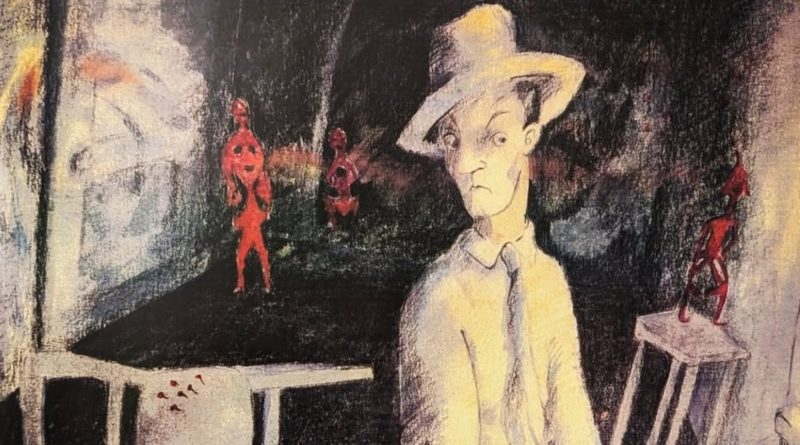
A work 30 years in the making, these dozen original songs about 12 citizens in a fictional town that Usher began constructing sometime in the mid-’90s alongside illustrator Laurie Webber, who brings each character to life with her vibrant use of color in the LP-sized 28-page book that accompanies the vinyl edition.
Sometimes the characters reference each other in a nod to Thornton Wilder’s Our Town on tunes fleshed out by a small wrecking crew featuring Andy York on guitar (John Mellencamp), Brian Griffin on drums (Brandi Carlile, Black Crowes), Andy Burton on keyboards (Ian Hunter) and David Mansfield on strings (Bob Dylan). Producing the album was Tony Shanahan of The Patti Smith Group, whose history with Usher dates back to their time in the unsung NYC band Eastern Bloc.
Rock & Roll Globe had the pleasure to correspond with Mr. Usher about the creation of Stevensonville, which is out now in a limited run of 200 copies via Strothard Bulldog Productions.
Was there a particular town you had in mind when coming up with this concept?
No, that was part of the fun. I was able to create the town and its various inhabitants as characters in both the songs and the illustrations, as I went along.
Edgar Lee Masters’ Spoon River Anthology and Thornton Wilder’s Our Town are both name checked in the press materials. How much did these books factor into the creation of Stevensonville?l
Both these and similar works (Winesburg, Ohio, etc.) offer a wide range of perspective by focusing on the thoughts and actions of small town individuals. I also borrowed a conceit from Spoon River by naming songs/paintings after the characters, as if they were “testifying.”

How have societal shifts in the last 30 years impacted the narrative of the album since it was first conceptualized?
Interestingly, society has remained largely the same, even if certain specifics have been altered by time. For instance, one of the characters, Martin Godfrey, laments his loss of privacy and his personal space being “invaded” by “soldier boys.” This was written years before the internet/smartphone explosion and decades before the recent government activities by ICE. Or the Reverend Thomas Pardee gives a “fire and brimstone” sermon, warning of a “new menace” coming down the street, without actually coming out and saying exactly what that “menace” might be. The white nationalist religious right always seems to be loaded with warnings like that.
How did you come up with the characters in these songs? Are they based on real people?
They’re based on people I’d run across or heard about, but I can’t say any of them are based on anyone I’d actually known.
What led you to Tony Shanahan for production duties for Stevensonville? How far do you guys go back?
We had both played in a band in the mid-’80s called Eastern Bloc. Ivan Kral (from the original Patti Smith Band) and my old friend, Mark Sidgwick put it together. We did one album on Passport Records. After that, Tony was in James Mastro’s Health and Happiness Show Band and I had been in at the very beginning of that. I was always lurking around, playing in different bands, while keeping a eye on my own. I ran into Tony again after a tribute show for the late writer, Scott Schinder. I was looking for a producer who had his own studio. We compared notes then and started making plans.
You have a pretty stellar band backing you here. How was this crew put together and what was the initial chemistry like?
Tony brought most of the players together. I knew guitarist Andy York from hanging arolund the Lower East Side. Great guy, but we’d never worked together. I didn’t know drummer Brian Griffin. But, both Tony and Jim Mastro vouched for him. Tony played bass. My old friend, Mark Sidgwick, played acoustic guitar throughout. I’d worked with keyboardist Andy Burton on some Edward Rogers recordings.The chemistry was terrific from the get go. Everyone was into the material and the concept. Tony had large reproductions of each painting made and as we approached each song, we hung the pertinent painting in the studio for inspiration.
What’s kept you in New York all these years?
I moved here from Cleveland in 1977 and I’ve never wanted to live anywhere else. Yes, I know there have been all the changes, including the disappearing mom and pop stores and neighborhoods and the proliferation of box stores and the very rich. I’ve lived in the same West Village apartment now for thirty years. And I still wouldn’t want to live anywhere else.

Back in the late ’70s, what were some of your favorite places to play and hang out in the city?
Well, if we’re talking late ’70s, I loved playing CBGB, even though I was well aware that its “heyday” had obviously come and gone. It was still a magical place and in the “late ‘70s,” it was before they raised the drinking age to 21. In those days, a whole new wave of college freshmen would come to New York and you had the ability to really build a following. About 1980 or so, they raised the drinking age and the whole club scene became, “how many friends have you got?” I was also able to play Max’s Kansas City in those days, before it closed. This was another place that seemed like “Oz”, when I was back in Cleveland. As far as hanging out, I could often be found at a place called Hurrah on West 60th, I think. This was a great club you had to ride an elevator to get to. It was the first and last place you would have seen me dancing, ha ha!
What are some of your current favorite places in the city?
It’s funny. The places don’t matter as much as the people in them. Now that I’ve been here almost 50 years, it’s the friendships that I’ve forged with other musicians, writers, etc. that transport me more than the bars and clubs that might disappear at any time.
What’s next following the release of Stevensonville?
Well, it took 30 years for Stevensonville to see the light of day, so it’s hard for me to actually “plan.” I have a number of smaller projects in mind. But, a lot depends on what happens with Stevensonville. I don’t know which way the weathervane will be pointing.

- Ween Unveils ‘Boognish Provides’ - October 1, 2026
- Artists Praise ‘Songs in the Key of Life’ for its 50th Anniversary - September 28, 2026
- Ringo Gets Back to the Garden - September 27, 2026
You May Also Like
-
 February 20, 2019
 -
 November 29, 2020
 -
 July 5, 2023
