
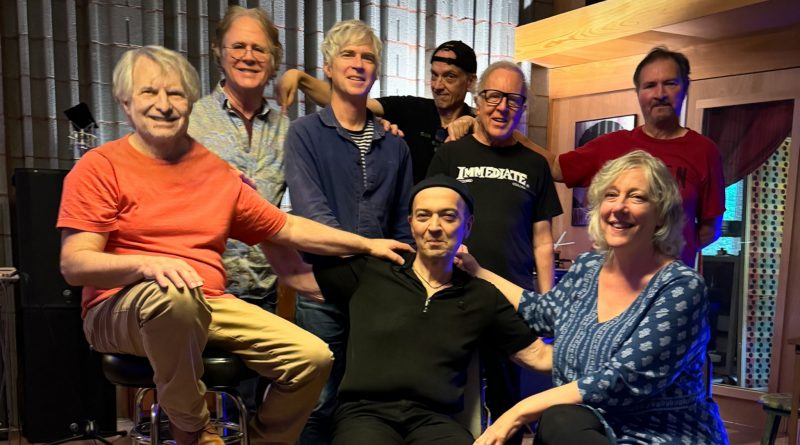
A Collective Worth Their Weight In ‘Salt’
A chat with guitarist Stephanie Schuck of North America’s coolest supergroup

It’s not everyday that one gets to meet their musical heroes, much less collaborate with them.
French medical researcher-cum-musical chameleon Stephane Schuck has managed to do both with his rotating-door ensemble The Salt Collective.
Consisting primarily of heavyweights from the ’80s American jangle-rock scene along with some ’90s alt-rock and indie stalwarts, Schuck’s three albums under the Salt Collective moniker echo those formative bands’ pastoral urgency while also staying informed by current musical technology and sounds.
Schuck was kind enough to take time out of his busy schedule in the lab to talk about the genesis of the project, the challenge of coordinating so many collaborators, and what’s next for the group.
I understand the genesis of the Salt Collective started with the earlier project SALT, which also included Ken Stringfellow and the underrated Anton Barbeau along with some of your French comrades. How did that evolve into the current iteration of revolving-door musicians?
At first, we were a French power pop trio. With Fred Quentin on bass, Benoit Lautridou on drums and me on guitar. We’ve been playing together since the ’80s. To trace the history of Salt Collective, you have to go back to the 90s when I became friends with one of my idols, Scott Miller, the leader of Game Theory and Loud Family. I composed music with him. As you know, unfortunately he passed away. and I ended up working on Game Theory’s posthumous album Supercalifragile. That’s where I met Ken and Anton. We worked together on Salt’s first album. Then I was put in touch with another of my heroes, Chris Stamey, and we started working together. We quickly wanted to experiment and push the collaborations further. So we naturally went from Salt to Salt Collective!
Unlike the debut, the new album A Brief History of Blindness, was largely created with many of the players in the studio at the same time. I’m sure that it’s no coincidence that the record sounds a bit shaggier and more organic than its predecessor. Was that an intentional move this time around?
Yes, completely. At the time of the Life album, we couldn’t do it for one simple reason: I was stuck in a sterile hospital room for five months being treated for leukemia. So, we did a lot of things remotely. For A Brief History of Blindness, we were lucky enough to be able to get together. Practically all the rhythm sections were recorded live in the studio. It was great! We could see each other, talk to each other, and feel the energy of a live performance. We’ll do it again for the next record.

The talent on the album is pretty staggering — Nada Surf’s Matthew Caws, Aimee Mann, Mike Mills, Mitch Easter, and half of the dBs among others — you must have quite the phone contact list! Does the younger version of you feel a bit starstruck that you’re working on music with, say, a member of R.E.M.? What’s the process for deciding on folks to contribute and how collaborative is the writing and recording process for you?
I’ve been living a dream since the beginning of this story, and I’m still dreaming. I know you love music and can imagine how I feel. Playing with the people who helped you grow musically, or even just grow up, can seem intimidating. But they are such brilliant and kind people that it feels completely natural… a dream come true, I tell you!
We have a fairly unique writing and collaboration process, I think; we’re not a traditional band. I write the music and refine it with Chris. Once we’re satisfied, we send the music to different singers who have complete freedom to write whatever they want, both lyrics and melodies, based on the music. It’s a purely collaborative process that brings us a lot of satisfaction.
Many of the musicians you’ve worked with arose out of the early-to-mid-80s “college rock” era in the United States and were contemporaries and comrades of one another. What was it about that loose collective of bands and time that caught your attention?
This was a very important period for me. I listened to all these bands when I was in high school and then as a medical student. This music was practically the soundtrack of my life. So I’m very sensitive to it; it’s like a time capsule. It brings back memories, some good, some bad. It’s the music of my life, so naturally I pay attention to it.
In addition to the American alternative rock of the 80s, your music also has a very contemporary feel. Who are some of the artists whose work is currently resonating with you?
Thank you! There are so many. I listen to music all the time. I was looking through my collection on my phone the other day, and I have 60 playlists of 30 songs that I’ve chosen, which I listen to randomly. I listen to it all the time… It’s very difficult to single out artists who inspire me because there are so many, but I can name a few: Super Furry Animals, Grass Show, Eggstone, Low, Eliott Smith, Suede, Chameleons. But I don’t know if we can say they are contemporaries.
Does your “day job” in medicine and health care inform the way you approach music? Or is music the release valve for you to express your passion?
Yes, it’s an outlet, but it’s also something complementary. When I was younger, people told me I was too rock ‘n’ roll to be a doctor, and too much of a doctor to be rock ‘n’ roll! I think both stem from the same desire to reach out to others, to reach out to people. Both fill me with energy and serenity. I couldn’t give up one for the other.
VIDEO: The Salt Collective feat. Lynn Blakey and Mike Mills “In the Shadow of the Moon”
Your guitar playing is quite incendiary. I hear bits of Richard Lloyd and Sonny Sharrock in your phrasing. Who are your influences, guitar-wise?
That’s a huge compliment, and it touches me deeply. I’ve always considered myself an average guitarist. My playing is very instinctive; I often find interesting things by accident rather than through pure reflection on music theory. I do a lot of experimentation on my demos. On average, there are at least 10 guitar tracks, so we often have to pare things down. As for guitarists I admire, there are so many! Andy Partridge is a monster when it comes to chords. Scott Miller from Game Theory had an incredible style of playing and was a huge influence… and then there’s Johnny Marr…
I imagine that given the wide swath of talent (and time) involved, scheduling a tour is likely out of the question. Do you have any performances lined up to perform songs from the Salt Collective catalog? If so, what does that look like?
You’re right to point out that it’s difficult to organize. But we already did it in 2024 with five dates on the East Coast and a concert in Paris. Playing the songs live has been one of the great joys of my life. We’re trying to organize new concerts for the summer of 2026. Stay tuned!
What’s next for you and the Salt Collective?
Our guitars are called “Desert Dust Guitars” and they’re awesome! The first series of 15 guitars will be released in February 2026. And otherwise, we’re working on the next album. I’ve written about fifteen new songs that have begun their long journey towards their final versions… it’s a new adventure!

- A Collective Worth Their Weight In ‘Salt’ - February 14, 2026
- Willie Nile Sheds A Little ‘Light’ - July 15, 2025
- Love, Loss and End of World: An Interview With John Lydon - October 3, 2023
You May Also Like
-
 October 7, 2025
 -

-
 May 11, 2018