
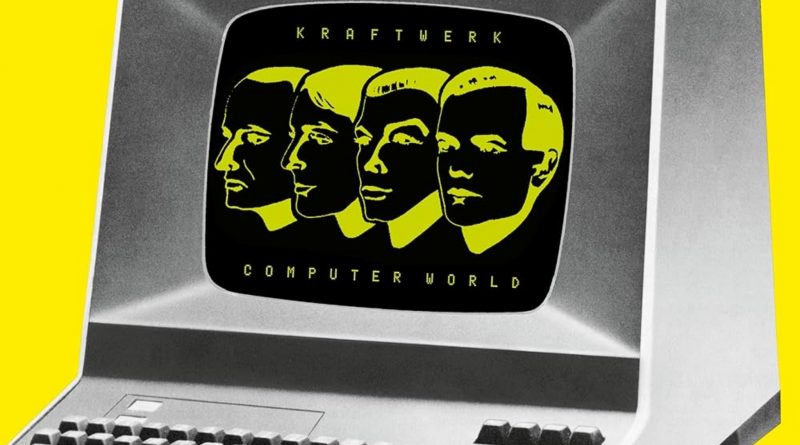
Numbers: Kraftwerk’s ‘Computer World’ at 45
The pioneering ’81 album forever altered hip-hop, techno and more

A lot changed between Kraftwerk’s 1978 album, The Man-Machine, and their 1981 follow-up, Computer World, but what it boils down to is that the world finally started catching up to the band.
In 1978, all-electronic bands were still a novelty. But by ’81, with sequencers, synthesizers and drum machines becoming increasingly sophisticated and accessible, synth pop had fully evolved from post-punk and New Wave, achieving mainstream ubiquity in the UK and elsewhere as a key component of what became known as the New Pop.
When The Man-Machine came out, most people still regarded the personal computer as the stuff of science fiction. But by the time Computer World appeared, IBM, Apple and others were perfecting the desktop computer as a household item, along with dot matrix printers, word processors, and other devices designed to ease our everyday entry into the electronic age.
The latter development is what inspired Computer World. The former is what enabled its creation. At last, the world was really ready for what Kraftwerk had to say. Sure, the German quartet’s biggest worldwide hit had come in 1974 with “Autobahn,” their only U.S. Top 40 appearance. But its widespread popularity probably had more to do with people perceiving it as a space-age version of a Beach Boys car song (which admittedly it kind of was) than any sort of zeitgeist shift toward techno-futurism.

The lads had long been toiling in their legendary Kling Klang Studio in preparation for this point in their timeline, staying a step ahead of the rest in onboarding the latest tech and even jerry-rigging some new tools of their own. By the time they began working in earnest on Computer World, though, the latest in synth and sequencer developments had begun making their vision a reality. So, they set about creating the concept album they were born to make, about humanity’s symbiotic relationship with technology.
Kraftwerk made that relationship very meta through some of their choices for sound sources. For example, on the title track that opens up the album, the band’s anthem for the age of the machines, all the lyrics other than the title phrase are generated from an electronic Texas Instruments Language Translator. Cutting-edge personal tech at the time, its artificial voice is heard blankly intoning, “Business. Numbers. Money. People,” etc.
The translator makes multiple appearances on the album, including “Pocket Calculator,” a salute to the 20th century offspring of the abacus. Like a lot of Computer World, the track is devilishly funky in a small-scale sort of way (Don’t forget, this is essentially dance music). Assisting the expected synths, sequencers, etc. are some carefully curated, handheld electronic devices that were more or less kids’ toys—a Stylophone and a mini-keyboard called the Bee Gees Rhythm Machine. Oh, and an actual calculator, of course.
Embracing a modernistic minimalism, the lyrics to “It’s More Fun to Compute” consist entirely of repetitions of the title. Kraftwerk came up with the phrase by adapting the slogan of a much more primitive mechanistic technology, the old Gottleib pinball machines: “It’s more fun to compete,” their version heard here through a vocoder to further blur the divide between device and human.
And for “Numbers,” where the lyrics are composed of numerals spoken in several languages, the translator, the vocoder, and an artificial voice simulator called the Votrax speech synthesizer all stand in for standard vocalizing. Today, it’s almost impossible to listen to this track (among others here) without picturing a crew of inner-city teens busting out their best breakdance moves. That’s because these affectless auteurs would soon rival James Brown for tracks sampled by hip-hop producers.
After Computer World, the booming population of hip-hop heads started digging deep into Kraftwerk’s bag of tricks for building blocks. In the ‘80s alone, “Numbers” was sampled not only for Afrika Bambaataa’s milestone “Planet Rock” (making it a defining element of Afrofuturism), but by Dr. Dre, Sir Mix-a-lot, Ultramagnetic MC’s, Cookie Crew, Biz Markie, 2 Live Crew, Run-DMC and The Break Boys, to name merely a mere few. And that’s not even getting into the sample scores racked up by the other tunes on the album, as well as older Kraftwerk cuts like “Trans-Europe Express.”
VIDEO: Kraftwerk performs “Pocket Calculator”
Not only was Computer World foundational to hip hop; it had a huge effect on multiple strands of subsequent electronic music, starting with electro, house, and techno and expanding ever outward. All told, the album made more of an impact on what music would sound like for decades to come than the 10 most influential guitar bands you can name from the same era.
But it’s not just Computer World’s place in history that makes it a go-to album for multiple generations 45 years after its release. For a record that purports to be about the increasing lack of humanity in our most prosaic interactions, it can be a compellingly emotional piece of work. Zoom in on the aching loneliness, longing, and isolation that exists at the haunted heart of “Computer Love,” for instance. And on the other end of the spectrum, a cut like “Pocket Calculator” is where even the machines learn how to let their circuit boards hang out and have a party.
It’s partly by maintaining so much negative space both musically and lyrically that Computer World creates its intrinsic timelessness. The smallest gestures are writ large, in a way they could never be on a more traditionally “emotive” album. Entire alternate universes can be projected onto these shiny metal surfaces.
Of course, the irony is that despite its early-adopter avant-tech aesthetic, this record was created by entirely analog means. Digital technology was not yet widespread in either recording or electronic music-making. By the standards of today, the tools employed in the making of Computer World were positively old school. Does that mean the album get bonus benefits for retro-futurism four and a half decades down the line? Maybe, but it benefits a lot more from just being a record full of straight-up bangers.

- Tim Sommer Punches Up for the ‘Outsiders’ - August 11, 2026
- How Herbie Hancock Turned up the Heat in New Jersey - August 2, 2026
- Is ‘Invisible Touch’ the Best Worst or Worst Best ’80s Pop Album? - June 8, 2026
You May Also Like
-

-
 December 24, 2018
 -
 October 2, 2024
