

Krishna Das: Have Harmonium Will Travel
A personal reflection on America’s rock ‘n’ roll yogi

There are musicians whose lives seem to take them straight up the stairway to stardom. They know where they are going, and they get there.
But back in 1970, no one could have predicted where a young man from New Hyde Park would end up. He might even have become part of Blue Öyster Cult.
When he left home for Stony Brook University, he was depressed and experimenting with drugs. He tried unsuccessfully to make his way into the music world there as a singer, hoping it would fill the void in his life.
He soon transferred to New Paltz State College, which, unlike Stony Brook, was located in the natural beauty of the Hudson River Valley, with its lakes like Minnewaska, mountain-climbable cliffs, waterfalls, streams and endless vistas. You could almost see all the way to Woodstock.
It was a magnet for a less academic counterculture, attracting musicians, bikers and hippies who wandered the isolated hills and the college halls, gathering in the well-known cafés along the town’s main street.
At New Paltz, he roomed at a friend’s place. From his own description, his roommates were “Jungian acid-head mountain climbers” — dropping tabs of LSD while rock climbing on risky vertical cliffs.
One day, a few of his friends asked him to come with them. They were going to meet someone named Richard Alpert. Recently returned from India, he now called himself Ram Dass.
He wasn’t interested.
They left.
He stayed behind to watch the two goats on the property.
A few days later, the car reappeared, crossing the open field to the house instead of taking the driveway. It looked like his friends were high.
The driver got out.
The young man remembers seeing “light shooting out of the driver’s head.”
Bored with the goats, he was ready for something new.
Immediately he said, “I’m leaving now!”
And drove off in his own car, with its screaming muffler and broken heater, into the freezing winter night.
Eight cold hours later, he arrived at the address they had given him and turned off the engine.
The house was in the middle of nowhere.
“The silence was so loud,” he recalls. “It was extraordinary.”
He walked the path to the front door in the dark, under the stars.
A strange-looking man with a big grin opened it and pointed upstairs.
Anxious, he thought, “I gotta get out of here. No one knows where I am.”
But he went in anyway.
Up the stairs.
At the top, he found Ram Dass sitting on the floor, his back against the wall, his eyes closed.
The young man walked into the room. Years later, he would describe what happened next simply:
“Something happened inside of me.”
Whatever he had been looking for, he suddenly knew was REAL.
And IT was in the world.
You could find IT.
“That was the beginning of the rest of my life.”
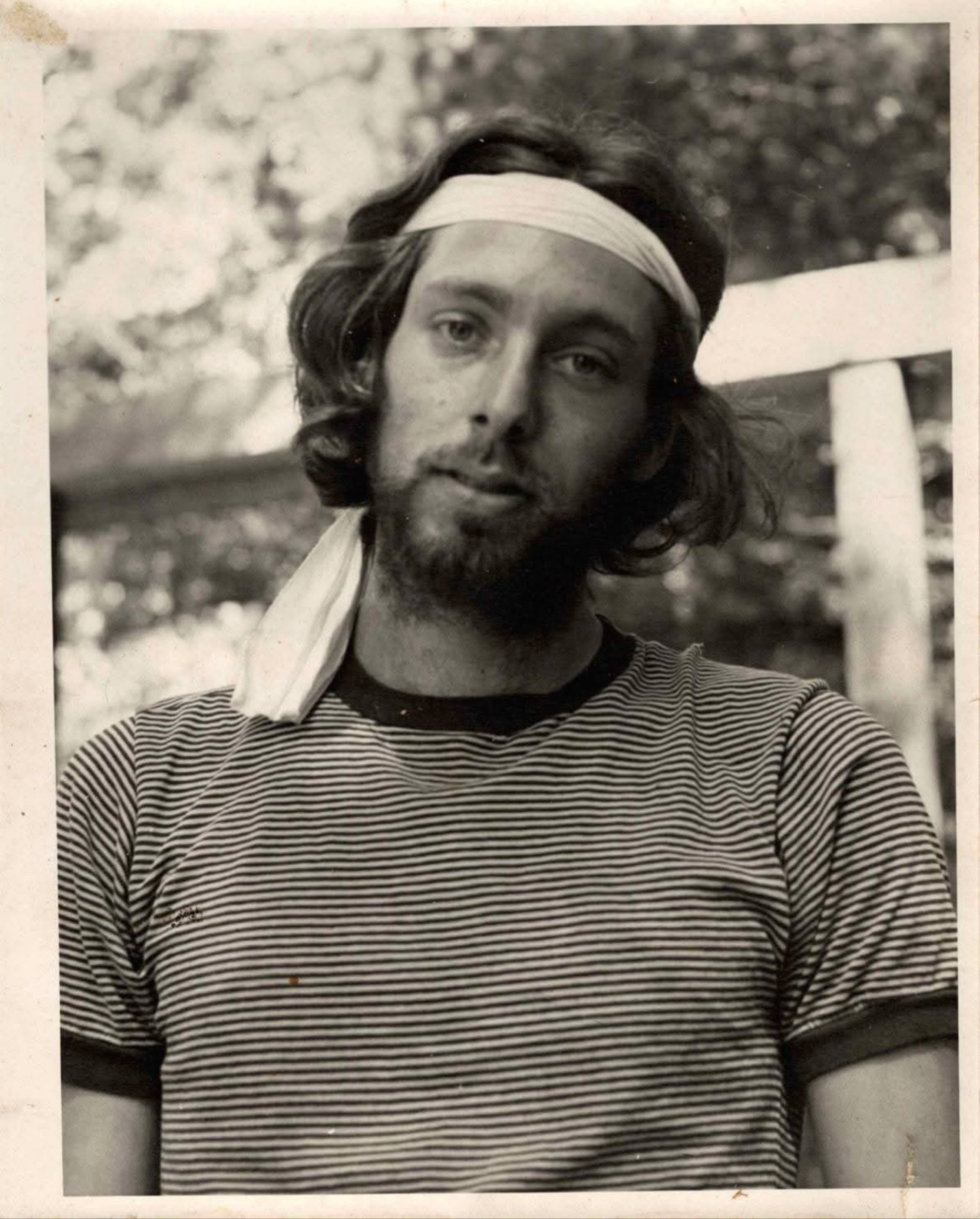
At first, he assumed that whatever he had experienced was coming from Ram Dass.
Ram Dass, he says, “very UN-gently disabused” him of that idea.
What he was experiencing, he came to understand, had come through Ram Dass from his teacher in India, Baba — Maharaj-ji.
The young man wanted more.
Some time after meeting Ram Dass, he left for India to find Maharaj-ji for himself.
When he encountered Maharaj-ji for the first time, something happened again. He says he immediately “chilled out.”
There was Ram Dass’s guru, wrapped in a blanket.
He remembers thinking, almost comically:
“How does all that LOVE fit in there?”
During the two and a half years he spent in India, he and the other Westerners discovered that Maharaj-ji loved to hear chanting in the style called Kirtan. They realized that singing gave them a way to spend more time near him. Maharaj-ji provided their basic needs.
More importantly, it was Maharaj-ji who gave him the name Krishna Das.
After two years, Maharaj-ji instructed Krishna Das that he needed to return to America to deal with his “stuff.” There was no way to properly work through it in India. He did so reluctantly, having expected to remain permanently near Maharaj-ji.
After some time had passed without Krishna Das, Maharaj-ji asked his staff where he was. They reminded him that he was in America.
Maharaj-ji asked him by letter to return to India and sing for him. Krishna Das responded, asking if he should come immediately.
Maharaj-ji told him to come in December.
But by September, Maharaj-ji had left his body.
Krishna Das left for India, but his teacher was gone.
Back in America, he says he carried “a knife in my heart.”
For the next 21 years, he lived with that pain — through grief, depression and drug use, struggling to hold on to and live with the gift and insight he had been given.
Hearing him reminisce today about those years — about Maharaj-ji and the loss that followed — Krishna remains visibly moved.
Slowly, over the decades that followed, he began returning to the practice that had connected him to his teacher.
With Maharaj-ji gone, Krishna Das says, “I have to do something to find him, and this is what it turned out to be.”
That “something” became the practice of performing Kirtan.
By the late 1990s, Krishna Das was beginning to make a name for himself in America. People were discovering yoga. Fate intervened on his behalf one afternoon at a concert in New York.
A businesswoman went to hear him at New York City’s 92nd Street Y as a favor to her yoga teacher.
She had grown up with Indian traditions of gurus and Kirtan. The idea of an American leading Kirtan did not exactly impress her.
She remembers seeing Krishna Das walk onto the stage dressed in black.
“And I thought, Oh my God, this is how a Westerner who’s going to be chanting—it’s going to be terrible.”
She smiles when she tells the story.
“See my biases, right?”
Then she heard him sing.
“As soon as I heard ‘Om. Shri Ram Jai Ram,’ three hours went by. I don’t remember what happened, but I was in the front of the room, right in front of him.”
She had come reluctantly.
She had initially sat in the back rows, expecting to leave.
Now she was as close to him as she could get.
Her experience did not end with that concert. She went back to India and tried to understand what she had felt.
Her father thought she had joined a cult.
She told someone in India that she couldn’t understand what she was feeling.
She was told:
“What you are feeling is Maharaj-ji.”
And she says:
“I knew I had found my guru.”
“There actually is a spiritual path for each individual soul.”
Decades later, half a world away and under circumstances unimaginably different, that idea of an individual spiritual path would surface in a cockpit. Badly wounded during the attack aboard a FlyDubai flight, Captain Smit Machchhar said he kept reciting the Hanuman Chalisa — the same prayer to Hanuman that became central to Krishna Das’s own spiritual practice.
She eventually provided Krishna Das with organizational help as he developed his web presence and marketing.
Originally, Krishna Das’s calling card was a subtle joke based on the classic TV Western series Have Gun Will Travel. It became Have Harmonium Will Travel. Of course, it represented his new life: traveling from venue to venue, singing and playing the harmonium.
Krishna Das is the young American Jeffrey Kagel of New Hyde Park, Long Island, who left university hoping to enter the rock music world, experimenting with drugs and searching for something he could not name. Something to give his life meaning.
Now, with the hope and happiness he found there, harmonium in hand, he was singing the Kirtan he had learned in India to Americans—and they came in numbers. Krishna Das’s music has accumulated tens of millions of plays online, and hundreds of thousands of recordings have been sold.
The audience became part of the music.
During the COVID years, Krishna’s Kirtan mattered even more.
When people, worried about contracting COVID, stayed isolated in their homes, Krishna Das began voluntarily broadcasting Thursday night concerts on the Internet.
VIDEO: Hanging in the Heart Space with Krishna Das in 2020
Week after week, he sang and spoke for roughly two hours and answered questions from the public in real time.
It was music, but it was also company.
He was not simply performing for people who were alone.
He created a strong, loyal community of people who were no longer alone. They were together with him.
And that may be one of the keys to understanding the unusual connection he has with his audience.
He does not claim to be the source of what people experience. He is freely passing on what happened to him through Ram Dass and Maharaj-ji — it was the practice they showed him.
The people who come to hear him chant with him become part of the practice.
Perhaps that is the connection between the long journey of Jeffrey Kagel and the man who is called Krishna Das.
What people are looking for is not necessarily somewhere outside themselves.
The possibility of happiness is already there inside.
Sometimes another person can help you find it.
The musicians who know that history will recognize the names of the artists who passed through Woodstock and Bearsville.
But Krishna Das’s story has traveled far beyond that mythology.
His music has reached people who know nothing about either town and may never have heard the name Maharaj-ji.
Krishna Das has sung in major concert halls like Madison Square Garden in New York and Wembley Stadium in London, in India, as well as in smaller yet important venues like Athar Shala Yoga Center in Delray Beach, Florida. During the years when the world was shut down, he kept singing to people in their homes.
Currently touring in 2026, Krishna Das is appearing in New York, North Carolina and Massachusetts, as well as in India’s largest cities, Delhi and Mumbai.
“If you don’t allow yourself to feel that terrible disappointment and the pain of not getting what you want, you’re never going to move through it, to get what you really want. It’s a big part of being human … and it bonds you with every other being on the planet.”
— Krishna Das
Krishna Das returns to New York on Nov. 21, 2026, for the Hanuman Chalisas NYC Retreat Weekend 2026.

- Krishna Das: Have Harmonium Will Travel - October 11, 2026
- Remembering Bonnie Tyler - July 12, 2026
- Murray the K and the Swingin’ Soiree - February 14, 2026
You May Also Like
-
 November 6, 2019
-
 December 12, 2023
-
 February 13, 2020
