
Inside the Brain of Nicko McBrain
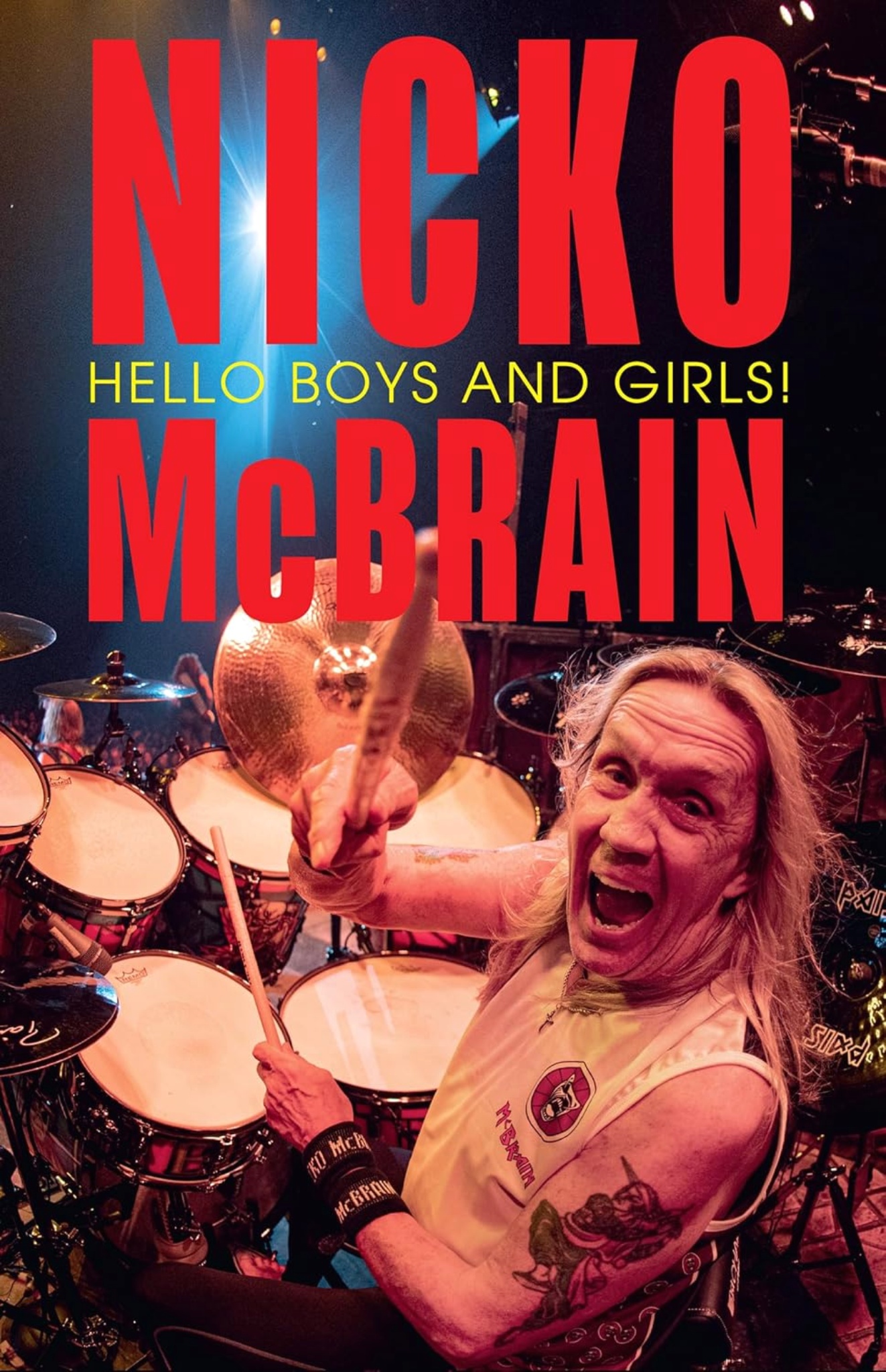
His brand new autobiography ‘Hello Boys And Girls!’ is available now
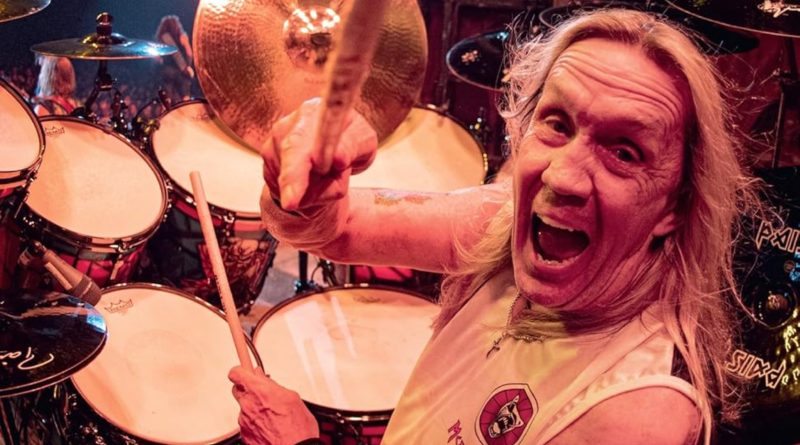
British drumming legend Nicko McBrain joined Iron Maiden in 1983, replacing the ailing Clive Burr on one of metal’s biggest thrones.
After suffering a stroke in 2023, he officially retired from Maiden in December 2024, leaving Steve Harris their eldest standing member. McBrain’s jovial new book tells his early life story in detail, although the pacing gets brisk during his tenure in Maiden. I was particularly fascinated by all the session work he did in England prior to joining French hard rock band Trust, from which he was eventually poached by Maiden.
[The following interview was edited for brevity and enthusiastic Hackney, UK mumbling.]
I just finished reading your book. It’s very much written in your voice, it seems. Did you work with it with an editor or ghost writer?
Yeah. It’s convoluted, but I started writing this book about 15 years ago. I was commissioned by a couple of guys [while] playing in this golf tournament that a friend of mine ran up in Orlando. He works for the Golf Channel and he had this tournament pro-celebrity thing. Rich Lerner. I was teamed up with this foursome and then two of the guys were publishers from New York. They own this publishing house and I was telling stories you know? This guy [said] “Hey man you ought to write a book” and I went, “Hmm, well, if I ought to write a book, you will publish it, being that you’ve got a publishing company?” So he talked to his mate, and they decided to commission me to write my autobiography.
That was probably 2012, 2013 lol. So I went gung ho, wrote about 21 chapters of the book and I hit a brick wall in about the first year of being commissioned… so then I didn’t do anything with it. I just procrastinated and I was on tour and you know doing the records with [Iron Maiden]. So it got left behind. By the way I had to give the advance back to ’em (laughs).
So then when I retired, [Iron Maiden manager] Rod [Smallwood] turned around and went, “Now Nicki, you can finish your bloody book. You’ve been too bloody lazy. I’ll go and get you a deal if you finish the book.” Moving forward a couple of months (this is back in the early ’25) I said to Rod, “Look, let’s get someone to help me finish it because you know if we’re gonna do it, let’s do it with somebody else to help me write it and finish the book.” So we got a guy called Ben Dirs and he done a couple of sports books. He did Geezer Butler’s autobiography, so I knew he had pedigree. We got together in London, got a cassette machine. Well hang on a minute. It wasn’t a cassette; it was one of those Dictaphone machines. You can’t find those anymore right, Nathan?
So, we sat down and he wrote a couple of chapters. I said, “No this is not me. We gotta make it more me. You know if you don’t want to do it, I’ll do it. I will write it.” And he said, “No, no. Give me a chance.” Then he wrote me another chapter and I went, “Ah, that’s it. You got my essence.” And then we worked and coordinated stories together and he finished it off for me. So I do tip my hat to Ben. Without him it would’ve been a bit of a struggle, I think.
Can you tell me about the title Hello Boys And Girls? What’s the origin of that?
I had a couple of different titles over the years, but my working title was You Just Never Know, Do you? because I always say that. That was my working title, which I gave to Harper Collins. And bless him, Rod went off and got his incredible deal with this wonderful publishing house. So then Dave Shack said to me (Dave shack is Dave Shackleton) we call him Shacky. He’s one of the management team below Rod and Andy Taylor and he’s now taking care of me. But he said, “Why don’t we call it Hello Boys And Girls? You’re always saying that every time I do an interview, I go, “Hello boys and girls!” For the radio. So it kind of came from that and Harpers wanted to go with the original version first and then they asked me: Would you mind changing it? Of course not. It’s nice and simple. “You just never know, do you?” that’s quite a mouthful, innit? LOL.
Most of the drummers and musicians who are a generation ahead of you, the Americans saw The Beatles on Ed Sullivan and the British guys got into skiffle. I liked that for you, your hallelujah moment was seeing “Take Five” by Dave Brubeck.
Absolutely. That was what set me up. That sent me on my journey. Joe Morello. I met Joe back in, I think it was like 2002. And he walked past this table [where] I was signing autographs at the music show in Anaheim with Bobby Rondinelli. Joe walked past with Dave Garibaldi and I stood up. “Excuse me, boys, and girls. You know I’ve got a Kodak moment. I’ll be right back.” And Bobby’s like “Where are you going?” I said, “Joe Morello’s just coming to speak to Eric Paiste.” He went, “I’ll be back as well.”
So both of us went and caught him, accosted Joe and Garibaldi and I remember the first thing I said. I introduced myself to Dave and then Joe. He was very gracious and I said, “Oh by the way, first off I’ve got a couple of things I’ve got to tell ya. My mum wants to meet you.” And this big grin came on his face like, “Oh she does, does she?” And I said, “No, not for what you’re thinkin.” LOL. “She wants to have a go at you because of the noise that I used to make because of you!” And then I told him about the Dave Brubeck story about when I saw him on telly and he just went, “Oh lovely.” You know he was so gracious it was wonderful and yeah, so that was that was the beginning.
AUDIO: The Dave Brubeck Quartet “Take Five”
Was he familiar with Maiden?
No. We didn’t really get into talking about Maiden. But I don’t think he was. Buddy Rich, on the other hand, he knew the band when I met him in 1986.
He complimented your right foot, right?
He did. He said, “You got a fast right foot.”
You pretty much could have retired right then.
LOL. Yeah, in the book [is] the story of when I first met him when I was 24 years old. I managed to get backstage at Ronnie Scott’s [jazz club] and I went and shook his hand. I thought: I’ll never wash it again. LOL. When I said it, I immediately thought, you’re an idiot. And that’s when he went, “Who do you play for boy?” I said The Streetwalkers. “Never heard of them. Bye.” And I got escorted out his little dressing room. It was funny but yeah Joe Morello was the man that was responsible for my journey.
But it also seems like your parents were pretty incredibly supportive, especially for the era.
Oh yeah. Absolutely. My dad was a trumpet player. So he had that musical experience. That was one of his loves. He wanted to be a pro musician, but he unfortunately lost a lung during the war and got tuberculosis and [that] stuff like really buggered him up. But he was supportive. My mum was supportive, but she wanted me to get a trade because she said “It’s a fickle industry. You need a trade fall back on.” And I said, “I have a trade, Mum.” “Oh no no no you’re gonna have to go to work and learn a trade.” So I went to college for four years and learned mechanical craft practice, which is all this engineering malarkey: lathe work, milling, grinding, blueprint… You know, “Here’s a drawing, make that!”
Has that come in handy ever?
LOL. Absolutely not! The day I left my job I gave my notice in. I was supposed to give a two week notice and my chargehand was a great guy. He said, “All right. You know you’re supposed to give two-weeks notice?” I said “No I’ve had enough. I can’t work in here anymore. I’m going pro.” I got my paper. I think they owed me some and I had to go back later on and get it, but that was another story.
So I get home and mum was like “What are you doing home?” And I was just about to tell her I was going pro with Mike Les[ley] and Billy Day and she said, “This just came for you.” It was a letter from the City and Guilds of England and she goes, “Open it!” And then mum starts dancing around room and then she says, “What are you doing home by the way?” And I went, “Mum, I’m gonna go pro. I’ve done what you’ve asked.” She said, “You wait ‘til your father gets home!” LOL So I knew I was in trouble with dad, right?
So there was a lot of love, but there were certain ground rules that I had to meet, you know for my mum. My dad was always, “You’re gonna be a massive massive player one day, son.
At least they got to see you in arenas.
They did. My mum and dad actually came over to the Powerslave rehearsals in Jersey. So they met the band and had dinner with us. Everybody was so wonderful to them. And then they come to the British tour. My dad saw us at Hammersmith Odeon a couple of nights and they were they were blown away. My mum didn’t care for the music. “Too bloody loud!” LOL. She was a Frank Sinatra/Nat King Cole girl for crying out loud you know?
Well in those days if your parents liked your band, you weren’t rocking hard enough so I think you did the right thing.
Very true, my friend.
I really liked reading about all the different session work you were doing in the early days, too. I didn’t know about “Nice One Cyril.”
Oh yeah yeah yeah yeah that was an adventure. A guy called Martin Clark was an A&R guy at EMI records. He used to commission me or give me session work with Brian Belshaw, Brian Godding, the old players from B.B. Blunder. Anyway one day [Clark] phoned us up. He said, “Listen. It’s not an EMI thing. But I’ve got a deal with this guy called Miki Dallon, who owns Young Blood records. He’s commissioned me to do an album and we want you to play it.” You know “the session.”
So anyway, me and the two Brians go into Pye Studios in Marble Arch. (I think it’s gone now). So we start work on this “Nice One Cyril” single… the premise was to do the single and then do an album. One side of the album was bought from the library. BBC used to have what they called the Library of Music and you could go and purchase a backtrack without vocals. So half of the album was done like that, from library music, and the other half we recorded.
We had to put vocals on it and there were only five of us in the studio. In those times you didn’t have 24 [tracks]. It was like eight tracks, and you got to put the drums and one guitar on the same [track and] premix it. Anyway we got this album deal out of it and then Martin would put in a bogus sax player or trumpet or trombone session player and make up the [invoice] and put it in to Young Blood and we’d get the money go buy drugs and beer with it! LOL! So this album was just complete mayhem. It was just nuts, but that was the story. It was called Cockerel Chorus Have A Party, which is what we did! LOL!
“Nice One Cyril” was a track on the record on that album, but it got to I think number 14 in the charts. It was a song for Tottenham Hotspur, the football club. A guy called Cyril Knowles was manager. I think he played for ‘em for a while and then he managed them. So it was a bit. “Nice One Cyril, nice one son. Nice one, Cyril let’s have another one” [Nicko continues to sing about half the song to me at this point…] “From the terrace and stand Spurs love him, man.” I can’t remember any more… LOL.
AUDIO: Cockerel Chorus “Nice One Cyril”
It must have been a thrill to have a recording on the charts at that point.
It was! I mean the first radio song I played on was a song called “Love will Keep Us Together” by Mac and Katie Kissoon. It was a Neil Sedaka written song and it was a hit for Neil in the US, but I did a session [for] Young Blood. That was the first radio single really that was commercially [available] that I actually played on. And then of course “Nice One Cyril” goes up in the charts, and I did Top of the Pops and Crackerjack, which was a kids show on television at the time. All live stuff you know? I mean back in the ‘70s I think you could record the backtrack but you had to do the vocals live. Of course, we’re a Cockerel Chorus so there were about 20 of us on stage. I wasn’t even playing the drums. They used the back track and it was the chorus.
From that time period were there any sessions you played on that were actually a little bit more rock or heavy rock or proto metal-oriented?
Not really, no. Sessions back in those days were more like: Go in the studio for three hours and do a single, which was two songs, a-side and b-side. Very rarely would you go and do a heavy song. You know I played with Gordon Giltrap. I did an album with him. He was more folk, but he wasn’t rock, you know?
I was looking up the Gordon Giltrap stuff. He got Simon Phillips to play drums for several records after the one you played on.
Did he really? Wow what a great drummer he is. He’s a lovely friend of mine, too. A stunning player. I love the stuff he did with Pete Townsend. You know that White City album was just off the charts.
AUDIO: Gordon Giltrap “When I See My Son”
I saw [Simon Phillips] in The Who in 89. That was cool. There isn’t a list of your early sessions anywhere on the Internet that I could find.
Probably not. It was all very convoluted stuff really. There wasn’t a lot really happening. I mean after the first year and a half of doing sessions I ended up joining Streetwalkers and then I was on tour. Did two albums with them.
Streetwalkers did some shows with Black Sabbath in Europe in 1975. You weren’t so into heavy metal yet, right?
No. I hung out with Ozzy and Bill Ward and all the guys. I went to watch a couple of their shows, but you know, the main thing I took away from it was Bill Ward had an oxygen tank next to his hi-hat stand. He was putting so much power into playing–and I was blown away with him–but I wasn’t a fan [of Sabbath]. So yeah, my style of music was Streetwalkers… that funky progressive rock, kind of vibe, you know? More bluesy.
And you know it’s a true story, apparently Ozzy saved my life. We were coming back on the ferry from Calais to London. We used to have parties… Me and the bass player [of Streetwalkers] were teamed up so we shared rooms cause we didn’t have a lot of money to spend. Roger had his own room. Charlie I think shared with Bobby Tench [who later joined the Jeff Beck Group] And me and [Streetwalkers’ bassist] Jon Plotel.
It was my turn for the room. Ozzy turned up, long trenchcoat on, and as he opened the door, saying “Could I come in?” He’s pulled out uppers in one hand and downers in the other. They were all falling over the floor.
I did this charity event with him called WaterAid [circa 2006]. And we did this thing where we did artwork on T-shirts [and/or wristbands]. They were going to sell these artwork pieces to raise money for WaterAid. So we did a launch in London. I hadn’t seen him in years. I thought, I’m gonna ask him if he remembers, ‘cause you know with his [Osbournes TV] show with Sharon [mimics bumbling Ozzy voice]… I thought he is a wreck. He won’t even remember what he did last week.
I said, “Do you remember the night that you came to my room, we were in Germany somewhere with Streetwalkers?” He goes, “I remember that cause I had a long trenchcoat on and I had some uppers in the one hand and downers in the other.” And I said, “For fuck’s sake, you remember that?” I was blown away. And then he said, “Do you remember me saving your life?” And that really hit hard because all I remember was the boat ride back being in a storm and it was very rough and raining.
He said, “Yeah I came out the back of the boat. You were about to fall out because the boat was rocking around and rolling.” And I was absolutely pissed–drunk right? And I [was about] to fall over the little barrier thingies. He said, “I saved your life. I pulled you back.”
You mention in the book how sometimes it’s easier to remember things from decades ago from last week.
Absolutely! LOL. It’s amazing. I mean I think as you get older, especially at my age you know there are moments of not so much clarity of what you did two weeks ago or what you had for dinner. But I certainly can remember more so things that happened in the last 40 years or 50 years.
What are you doing with your retirement?
Well, I’ve got my restaurant back open in Florida [Rock ‘N’ Roll Ribs]. We’ve got our 17th anniversary coming up December the 12th. My Titanium Tarp band [is scheduled to play]. We’ve got a rehearsal on the Thursday before that on the 10th because I don’t get back from my spoken word tour that I’m going on. I’m doing a book tour… that’s just here in England. And then I’ll get home on the fifth. So I have a couple of days back in Florida and then we got rehearsal and then a party and then next year we may be doing a US tour… spoken word. We’re gonna have to see how this [book tour] goes before we book anything for the US. Maybe South America.
But yeah. There’s so many other stories that I could’ve put in [the book]. Maybe I’ll get [to write] part two. Who knows?
We got a second Rob Halford book and it was a treat. Obviously there’s so many more stories you could tell. So many of the chapters, particularly of the heyday of Iron Maiden go by pretty quickly. So I would encourage you to write that second book.
Thank you very much. There was a story when I spoke to [Iron Maiden bassist ] Steve [Harris] a couple weeks ago. He said “Have you got the Lake Geneva story in your book?” And I went “Hmm, no mate.” He went, “You what? Oh I was really looking forward to reading that story.” That’s a story for another day. So he was disappointed. I did write it into the book, but Rod turned around and said, “I think you better not put that in the book.” I agree with him. It’s a little bit risqué. It could upset especially the wives.
VIDEO: Streetwalkers Live 1975
The rumor is that they cut 2/3 of Geezer Butler’s book, just for legal purposes.
There is that, too. You know obviously the legal department of any publishing company have to get hold of it. And they read it and they go, “This is libel. This is not right. Is this really what happened?” My story with Pat Travers… they said you need to get this signed off by Pat. Now Pat and I are great mates today. We weren’t back in the late ‘80s going the early ‘90s when I made my peace with Pat. But the water that went under the bridge was a bit murky to say the least. And you know there were some stuff in there that I wrote that I had to get him to sign off on. And he was fine with it. He said, “Yeah okay. That’s not how I remember it, Nick.” I said, “Well that’s how I remember it, so bugger you, Pat” LOL.
Why is it that you didn’t want to get into playing double bass?
Well, you know I was influenced by four of the greatest drummers in the world: yRingo, Charlie Watts, Keith Moon… although Keith had two bass drums he very rarely, in fact I don’t even know one song that he played two bass drums on. And he didn’t have a hi-hat. He never had a hi-hat. But he’d have a [second] bass drum. I asked him, “Why you got two bass drums?” He said, “I can put more drums on the second bass drum.” And I went, “Oh! Of course you can. Yeah, brilliant.”
So then John Bonham. And that was what I kind of molded my style of playing on: those four guys, they were the influence. And Joe Morello… you would’ve thought I’d be playing jazz, wouldn’t ya? That’s what I grew up listening to. The Beatles, Rolling Stones, you know, Zeppelin. And The Who My Generation for crying out loud. I was like, “Who’s this guy playing?” Single bass drum players. All of ‘em. The only [double bass] guys [back then] really were Ginger Baker, and then before him it was Louis Belson and Ed Schaughnessy. And I wasn’t really aware of those guys until much later in my life.
Ginger Baker… I was never really a fan of his playing. He used a double and he was the first real player. And then Cozy [Powell] came along and it was, “Oh, okay. I get it.” But I always thought it was un-drummer-like to use two pedals. And although this is an ass-about-face reason it is actually totally wrong. I always used to say to people, “Why, when I have I have so much difficulty with one, why compound the issue and put two up?” When you’re used to doing 16th notes, there’s only eight on each bass drum. So you know you’re playing a 16th note grouping or subdivision and one foot’s doing eight beats and the other doing the other eight, in-between. So it’s easier to do that kind of feel than actually doing it with one [kick drum] cause he’s doing all the 16th notes on his own. So it’s ass-about-face but that’s how I used to explain it. “Why compound the issue and use two, cause one’s bad enough?”
And then I see people like Terry Bozzio come along, and Billy Cobham, and the wonderful Thomas Lang now. Oh gosh, these people you know…it’s another art to drumming using that left bass drum and how you incorporate that into your rhythms and structures.
I got to see Billy Cobham’s Spectrum 40 tour and it blew my mind. I’d never seen anyone play with four drum sticks before. How big is your kit in Titanium Tarts?
Well on the last tour, we did five gigs a couple of months ago and I took the [Iron Maiden] Future Past kit out. The whole thing. And the gong. LOL. And I bashed that gong in between every song! At the end of the end of “Stranger in a Strange Land”: boom — just cuz it’s there.

- Inside the Brain of Nicko McBrain - November 22, 2026
- Bruce Dickinson Flies Solo Again with The Mandrake Project - March 14, 2024
- Heavy Duty: Judas Priest’s Defenders Of The Faith at 40 - January 19, 2024
You May Also Like
-
 September 13, 2026
-
 December 7, 2023
-
 November 15, 2019
