

The Bangles’ Different Light Turns 40
Basking in the glow of their smash 2nd LP

Groups composed entirely by women have always been an integral part of the American pop trajectory.
It’s a lineage that dates back to the early-to-mid-60s when groups like Goldie and the Gingerbreads, The Pleasure Seekers (featuring a young Suzi Quatro) and The Shaggs first arrived on the scene with Fanny not too far behind.
Yet it wasn’t until the dawn of the punk and new wave era did all-women bands really make their mark on the charts. And one of the groups who helped pave the way during that time was The Bangles out of Los Angeles, emerging in 1981 as part of the Paisley Underground movement.
The band — Susanna Hoffs (vocals, guitars), Vicki Peterson (vocals, lead guitar), Michael Steele (vocals, bass) and Debbi Peterson (vocals, drums) — followed in the path of similar groups like The Runaways, Girlschool and The Go-Go’s in a quest to craft a highly credible sound that could engage the masses.
“Even though The Go-Go’s were not the only all-female band in LA at that time, they had really good songs, personalities, and a strong belief in what they could accomplish,” Vicki Peterson suggested in an exclusive interview with Rock and Roll Globe. “What they did for us and other women was to show the mostly male record industry that record buyers would buy an album made by a group of women. It seems ludicrous now, and it was ludicrous then, but there were many in A&R who didn’t believe it could be done. The Go-Go’s made an irresistible album in Beauty and the Beat, and that certainly helped.”
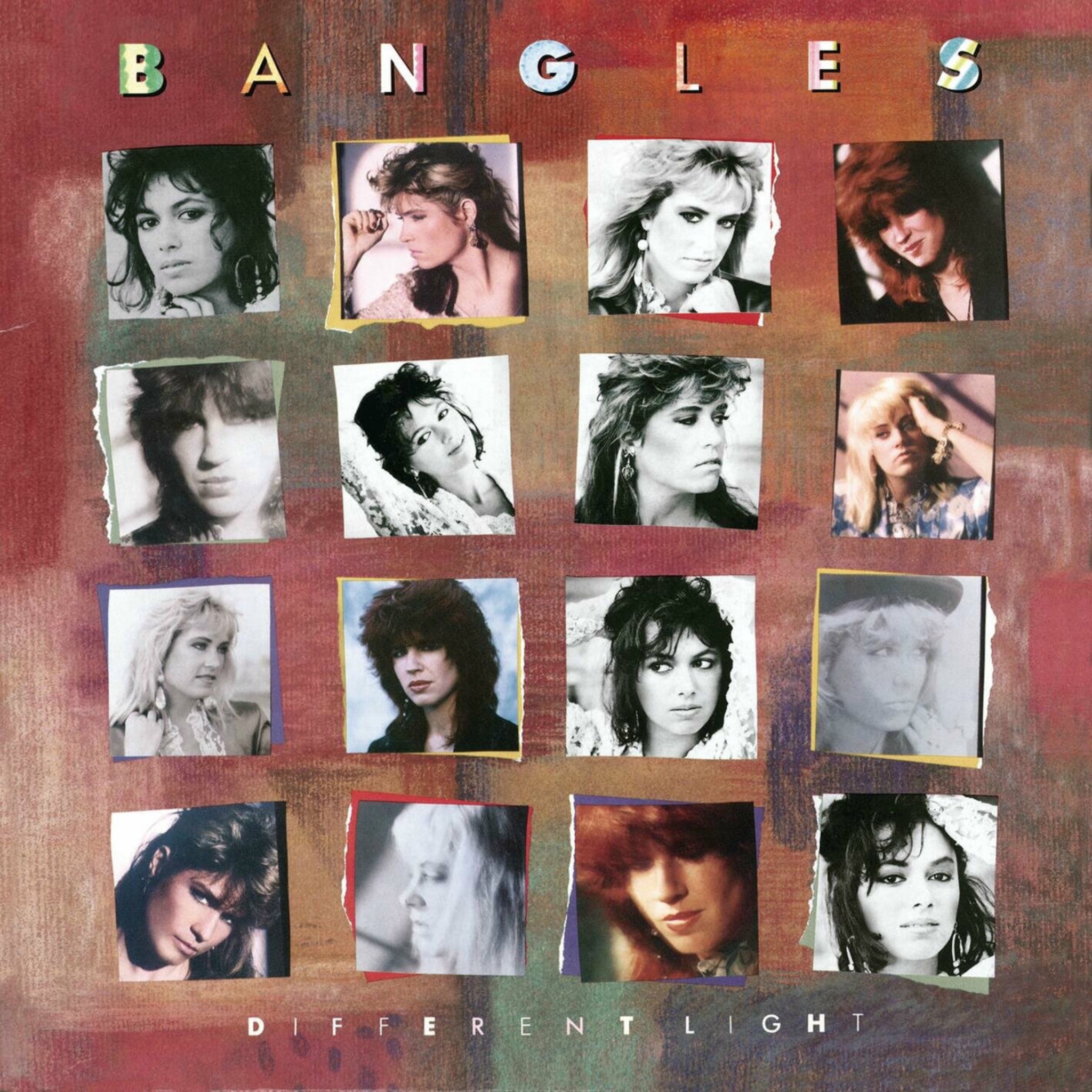
With their own sophomore album Different Light, released 40 years ago on Jan. 13, 1986 by Columbia Records, The Bangles suddenly started getting the well-deserved recognition that they themselves were due. While their debut, the auspiciously dubbed All Over the Place, established their debt to the jangly ‘60s influences that percolated alongside such fellow Paisley Underground greats as Rain Parade and The Three O’Clock, Different Light, true to its title, managed to meld their earlier inspiration with a more rock-centric approach that was easily compatible with the pop trends of It yielded no less than five charting singles, one of which, the instantly infectious “Manic Monday” was written by Prince under the pseudonym “Christopher” and originally intended for the group known as Apollonia 6.
“We were told that Prince saw the video for ‘Hero Takes A Fall’ and was taken with the band,” Peterson recalls. “He was famously supportive of women musicians and would mysteriously show up at performances with no advance notice, simply appearing in the wings. Sometimes our managers would let us know mid-show that he was there and wanted to play, but it always seemed somehow magical to me. He would join us onstage, singing ‘Manic Monday’ with us, or I would happily hand him my guitar so he could play an old rock ‘n’ roll song at the encore.”
VIDEO: The Bangles “Manic Monday”
Several other tracks on the album made a decided impression as well. The decidedly quirky “Walk Like An Egyptian” created a mild dance craze while making its ascent to the No. 1 chart position in the U.S. and other parts of the world.
Although it didn’t chart quite as high, the second single from the album, the overtly engaging “If She Knew What She Wants,” written and originally recorded by Jules Shear, also emerged as one of The Bangles’ signature songs. It was originally written in the first person, but for their version, the Bangles rewrote the lyrics in the third person because they felt it would be more appropriate. “Walking Down Your Street” emerged as another stand-out; while it didn’t reach the Top Ten, it was a simple yet sturdy offering that also marked the first time a sole composing credit was given to a member of the band — in this case, Susanna Hoffs.
“Different Light is a complicated album for me, because while it did light a fire under our career and allow us so many new opportunities, its production came close on the heels of 18 months of touring, and so in some ways, it felt rushed to me,” Peterson reflects. “We did not have sufficient time to write together (or individually) and the label was pushing hard for ‘singles.’ I am grateful for the songs that did come our way from other writers, but I would have preferred to have more of our own work on the album. That said, there are some fine, fine songs here!”
VIDEO: The Bangles “Walk Like An Egyptian”
While several of the songs on the album were contributed by outside writers, many of the tracks did offer the individual Bangles opportunity to flex their songwriting skills, albeit as co-writers with outside collaborators. Hoffs emerged as the band’s primary composer courtesy of the title track, “Return Post,” “Angels Don’t Fall,” and co-writing credits on “Walking Down Your Street,” “Standing In the Hallway,” “Not Like You” (with Debbi Peterson), “Let It Go” (with Vicki Peterson). Steele wrote and sang the song “Following.” Producer David Kahne also contributed to the writing of some songs as well.
The album received stellar reviews on its release, most critics and publications awarding four out of five stars.
Billboard stated, “The Californian quartet’s spare ‘60s-influenced pop/rock gets a facelift from producer Kahne, who shepherds the band’s shift toward a more emphatic pop sensibility by focusing on a lusher, more layered vocal sound.” Cashbox added the band had “taken its ragged L.A. street image and polished it for what looks like a national campaign,” noting that the album’s “American sound, repleat with guitar-laden nascent psychedelia” makes it “right in line with current musical taste. Rolling Stone said that the album succeeds in “covering their roots without burying them ten feet under,” and added and felt that the album “puts then and now in significantly better balance”, while also finding that the band had advanced “past the fan-apes-idol phase” in their trajectory.
“It felt to me less like a rocket ride than a slow, then increasingly accelerating, climb up a roller coaster,” Peterson adds in retrospect. “We had been working for a number of years, playing LA area clubs and gaining attention there; our first major label album was not a gigantic success, but got things rolling for us on the college radio level…slowly picking up speed. I was not ‘surprised’ per se when Different Light was the success it was, because I always believed that if we were given a chance, we could break through.”
VIDEO: The Bangles “If She Knew What She Wants”
Indeed, it was more than a sonic achievement. It helped prove the point that a band made up entirely of women could hold their own with any of their male competitors. In that regard, they broke the so-called “glass ceiling” when it came to making their mark in what had previously been male-dominated playing field.
“I know that I kept my blinders half-on at select times, intentionally not seeing some of the insanely sexist stuff that was flung our way,” Peterson allows. “What I did see were the other women around us who were also working hard in the almost exclusively male world of music making. It’s strange to think of now, but I only knew of one female engineer (Peggy Leonard) and one producer (Trina Shoemaker)…and even though we knew other female musicians in LA, there were some, but not many, bands. I never thought that our gender should, or frankly would, keep us back.
“I still to this day though, love it when a young woman comes up to me and says that because of The Bangles, she picked up a guitar, or sat at a drum kit, believing that she could be a songwriter or musician.”
VIDEO: The Bangles “Walking Down Your Street”

- High Voltage!: AC/DC’s ‘Dirty Deeds Done Dirt Cheap’ Turns 50 - September 21, 2026
- Remembering Dolly Parton - August 26, 2026
- More Than A Feeling: ‘Boston’ Turns 50 - August 25, 2026
You May Also Like
-
 April 17, 2023
 -
 December 12, 2023
 -
 October 28, 2018
